The Science and Philosophy of Reincarnation in Hinduism: Can Ancient Beliefs and Modern Science Meet?
The belief in reincarnation is one of the oldest and most fascinating ideas in human history. In Hinduism, reincarnation is a central concept that describes life as an endless cycle of birth, death, and rebirth.
According to this belief, human existence does not end with death. Instead, the soul continues its journey through different lifetimes.
The science and philosophy of reincarnation have attracted people for thousands of years. Sacred Hindu texts such as the Bhagavad Gita and the Upanishads explain that the soul is eternal and moves from one body to another.
Today, as science continues to explore consciousness, memory, and the possibility of life after death, many people wonder whether modern research can provide new insights into reincarnation facts and the mystery of human existence.
This article examines the science and philosophy of Reincarnation in Hinduism by combining ancient Hindu wisdom with modern scientific ideas.
Although religion and science often approach reality in different ways, both attempt to answer important questions about consciousness and what happens after death.
According to Hindu philosophy, the soul, or Atman, is immortal. It passes through many lives until it reaches moksha, which is freedom from the cycle of rebirth.
The human body is considered temporary—a physical vessel that houses the soul for a limited time. After death, the soul continues its journey, carrying the effects of its actions, known as karma.
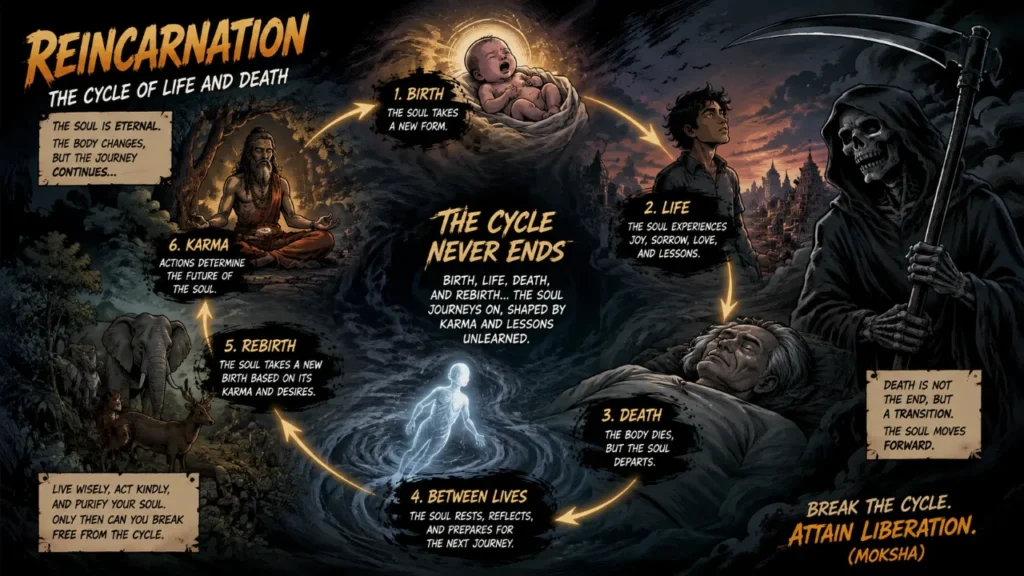
One of the most important reincarnation facts in Hinduism is that every action influences future lives.
Good and bad deeds create karma, which determines the circumstances of the next birth.
The soul also carries samskaras, or impressions from past experiences, that shape future behavior and personality.
Because of this connection between actions and future lives, Reincarnation in Hinduism is seen not only as a spiritual belief but also as a moral system.
The philosophy of rebirth teaches that ethical choices, compassion, and personal growth affect the soul’s journey across lifetimes.
Modern researchers studying consciousness and life after death continue to investigate questions that have fascinated humanity for centuries.
While science has not yet provided definitive proof of reincarnation, ongoing studies into memory, near-death experiences, and consciousness keep the discussion alive, creating an interesting connection between ancient spiritual traditions and modern scientific inquiry.
- What Is Reincarnation in Hinduism?
- 3 Surprising Reincarnation Facts That Continue to Fascinate Researchers
- 3 Shocking Reincarnation Examples and Stories That Still Puzzle Researchers
- Is there any scientific evidence of reincarnation?
- What does Hinduism say about reincarnation?
- Can children remember their past lives?
- How does karma affect reincarnation?
- What is the difference between reincarnation and rebirth?
What Is Reincarnation in Hinduism?
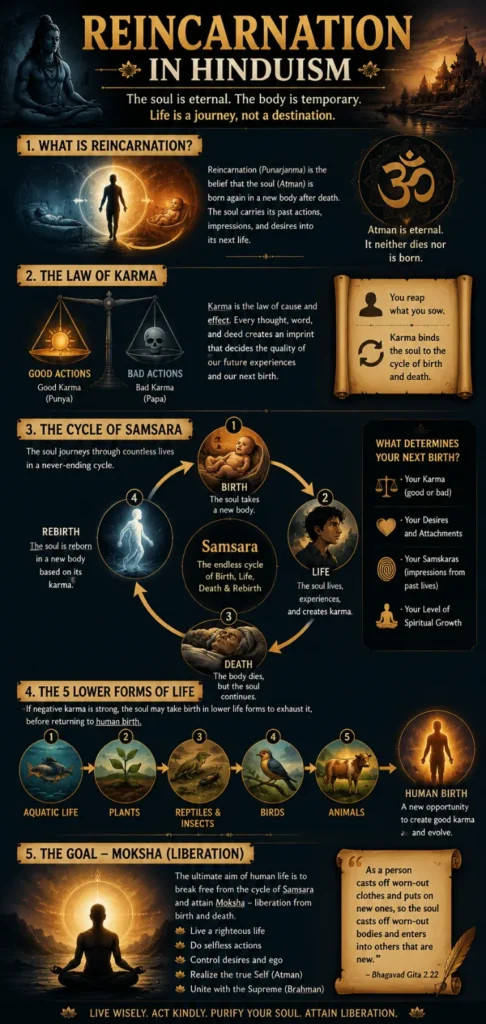
In Hinduism, the process of reincarnation is governed by two important concepts: samsara and karma. These ideas form the foundation of the science and philosophy of reincarnation and explain how the soul moves through different stages of existence.
Samsara refers to the continuous cycle of birth, death, and rebirth.
According to Hindu beliefs, the soul leaves the physical body after death and enters a new form of life. Karma, on the other hand, is the law of cause and effect. It teaches that every action a person performs creates consequences that shape the future journey of the soul.
One of the most important reincarnation facts in Hindu philosophy is that good actions create positive karma, while harmful actions produce negative karma.
After death, the soul is judged according to the karma accumulated during its lifetime. This is the most common concept of Reincarnation in Hinduism.
People who collect good karma are believed to move toward higher spiritual states, while those who accumulate negative karma may return to Earth in lower forms of life, such as plants or animals.
According to traditional Hindu teachings, karma can only be earned while living as a human being.
Souls carrying negative karma must completely exhaust its effects before they can be reborn as humans again. Once reborn in human form, they receive another opportunity to perform righteous actions and continue their spiritual journey.
Similarly, souls that reach higher spiritual realms because of their positive karma do not remain there forever.
Their stay in these heavenly planes lasts only until the good karma that brought them there has been exhausted. After that, they also return to Earth in human form.
Hindu philosophy further explains that souls burdened with negative karma may pass through different lower forms of existence based on the amount of karma they must overcome.
These forms are traditionally ranked as aquatic life, plants, reptiles and insects, birds, and animals. A soul may progress through these stages before eventually returning to human life.
According to the philosophy of rebirth, the cycle of samsara is often viewed as painful and limiting.
For this reason, devoted Hindus seek to accumulate good karma and follow a righteous path in order to escape the endless cycle of reincarnation and ultimately attain moksha, or spiritual liberation.
3 Surprising Reincarnation Facts That Continue to Fascinate Researchers
Although Reincarnation in Hinduism is primarily a spiritual belief, it has also attracted the interest of scientists and researchers.
Over the years, many studies have explored cases involving unusual memories and experiences that some people believe could be connected to past lives.
These cases remain an important topic in the science and philosophy of reincarnation.
Here are three fascinating reincarnation facts that continue to spark debate around the world.
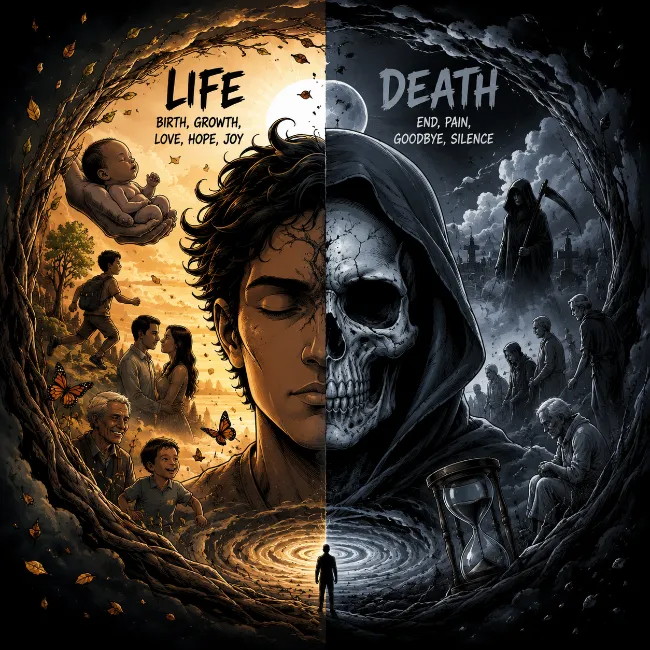
1. past-Life Memories in Children
One of the most interesting reincarnation facts involves young children who claim to remember details from previous lives.
Some children have shared stories about places, people, and events that they could not have known through ordinary means.
In many cases, these memories begin at an early age and gradually disappear as the child grows older.
Researchers studying the science and philosophy of reincarnation consider these accounts important because some of the details appear to match the lives of deceased individuals.
Read : How to Enter a Trance State: 10 Safe and Effective Techniques
2. Birthmarks and Physical Similarities
Another intriguing aspect of Reincarnation in Hinduism and research involves birthmarks and physical features.
Some people are born with marks or unusual physical characteristics that closely resemble injuries or wounds suffered by individuals they claim to have been in a previous life.
Although science has not confirmed a direct connection, these cases continue to raise questions about whether physical traits can somehow carry over from one lifetime to another.
3. Memories of Historical Events and Ancient Cultures
Certain individuals have demonstrated surprisingly accurate knowledge of historical events, foreign languages, or ancient cultures despite having no known exposure to them in their current lives.
Supporters of Reincarnation in Hinduism believe that these memories may come from experiences stored deep within the subconscious mind.
This phenomenon has become an important area of discussion in studies related to consciousness, life after death, and the philosophy of rebirth.
While modern science has not yet provided definitive proof of reincarnation, these unusual cases continue to inspire researchers to investigate the mysteries of memory, consciousness, and human existence.
3 Shocking Reincarnation Examples and Stories That Still Puzzle Researchers
The science and philosophy of Reincarnation in Hinduism become even more fascinating when we look at real-life stories that have attracted worldwide attention.
Over the years, several cases involving past-life memories and unusual experiences have fuelled discussions about consciousness, life after death, and reincarnation facts.
Here are three remarkable reincarnation examples that continue to intrigue researchers and spiritual seekers alike.
1. The Story of Shanti Devi
One of the most famous stories comes from India related to Reincarnation in Hinduism. Shanti Devi, who was born in 1926, claimed that she had lived a previous life as a woman named Lugdi Devi.
From a very young age, Shanti described details about her former family, her hometown, and events from her past life.
Her statements attracted public attention and led to an official investigation.
During the inquiry, many of the details she provided reportedly matched the life of Lugdi Devi, making her case one of the most widely discussed reincarnation facts in history.
2. The Case of James Leininger
Another well-known example is the case of James Leininger, an American boy who began having vivid memories and recurring nightmares related to World War II.
James claimed that he had been a fighter pilot in a previous life.
He described specific details about military aircraft, the aircraft carrier on which he served, and even the names of fellow pilots.
Researchers later verified many of these details, leading some people to consider his story an important case in the study of reincarnation and consciousness.
Read : 7 Dark Night of the Soul Stages Explained
3. The Pollock Twins Mystery
The story of the Pollock twins, born in England in 1958, remains one of the most unusual Reincarnation in Hinduism examples ever recorded.
The twins reportedly remembered places, people, and events connected to the lives of their older sisters, Johanna and Jacqueline Pollock, who had died in a tragic car accident before the twins were born.
Their memories and behaviors closely resembled those of the deceased sisters, leading many researchers and spiritual thinkers to question whether reincarnation could explain such similarities.
These stories do not provide definitive scientific proof of reincarnation, but they continue to inspire discussions about the science and philosophy of reincarnation, past-life memories, and the mysteries of human consciousness.
Conclusion: The Science and Philosophy of Reincarnation in Hinduism
Reincarnation is a fascinating concept that has shaped spiritual traditions for thousands of years.
Deeply rooted in Hindu philosophy and supported by many intriguing stories and reincarnation facts, it offers a unique perspective on the journey of the soul and the possibility that life extends beyond a single existence.
The science and philosophy of Reincarnation in Hinduism encourage us to think about some of humanity’s biggest questions: What happens after death?
Does consciousness survive beyond the physical body? Can memories and experiences continue across different lifetimes?
Although modern science has not yet provided definitive answers, ongoing research into consciousness and past-life memories continues to fuel curiosity and debate.
Whether viewed as a spiritual belief, a philosophical idea, or a subject of scientific investigation, reincarnation invites us to explore the deeper meaning of life and our place in the universe.
Reincarnation in Hinduism reminds us that many mysteries surrounding human existence remain unsolved.
As discussions about reincarnation facts and life after death continue, one thing is certain: the search for answers inspires us to keep an open mind and consider the endless possibilities that may exist beyond the cycle of birth and death.
FAQ: The Science and Philosophy of Reincarnation
Is there any scientific evidence of reincarnation?
Although there is no conclusive scientific proof of reincarnation, researchers have investigated cases involving past-life memories, near-death experiences, and unusual childhood recollections. Some studies suggest intriguing connections, but modern science has not yet confirmed reincarnation as a proven phenomenon.
What does Hinduism say about reincarnation?
According to Hindu philosophy, the soul is eternal and moves through a cycle of birth, death, and rebirth known as samsara. A person’s actions, or karma, influence the circumstances of future lives. The ultimate goal is to achieve moksha, which is liberation from the cycle of reincarnation.
Can children remember their past lives?
Some children have reported vivid memories of people, places, and events that they claim belong to a previous life. These memories often appear between the ages of two and six and may gradually disappear over time. While some researchers consider these cases significant, others believe they can be explained by psychological factors.
How does karma affect reincarnation?
In Hinduism, karma refers to the consequences of a person’s actions. Good deeds create positive karma, while harmful actions create negative karma. According to the philosophy of rebirth, karma determines the conditions of a soul’s future lives and spiritual progress.
What is the difference between reincarnation and rebirth?
Reincarnation usually refers to the soul taking birth in a new body after death, while rebirth is a broader concept that can include spiritual transformation and the continuation of consciousness. In many Eastern traditions, both ideas are closely connected and describe the ongoing journey of the soul.