
Sun gazing or sun meditation known as Surya Trataka is a yogic concentration practice in which the sun is the point of focus. The name comes from Sanskrit, where surya means sun and trataka means steady gazing.
That’s simple a yogic practice of concentrate on sun for meditation.
Traditionally, it is described as a way to build concentration, inner stillness and a sense of connection with the natural world, which is why it appeals to many people who already practice candle or bindu trataka.
Before going further, there is something every reader should know. Sun gazing can be a harmful practice if you don’t follow safety precaution measurement.
Eye doctors warn that it can cause solar retinopathy, a burn to the center of the retina. The damage can happen in seconds, it is often painless at the time, and there is no known treatment. Sunglasses do not make it safe. Practitioner who do it with curiosity and forcefully intention get a temporary or permanent eyesight damage later.
This is why many online guides on Surya Trataka deserve caution, and why this one does not tell you to stare at the sun.
What sun meditation does offer is a clear, honest look at the practice. You will learn what Surya Trataka means, where it sits within the wider trataka practice, and what practitioners say it offers.
Don’t try to do it directly instead of practicing other practice first like bindu trataka, Shakti chakra trataka then candle gazing and moon gazing as they are basic to advance practice and enhance your ability to perform complex trataka.
You will also see why eye specialists advise against direct sun gazing, who should avoid the practice altogether, and which safer approaches can give you a similar experience of focus and calm without putting your eyesight at risk.
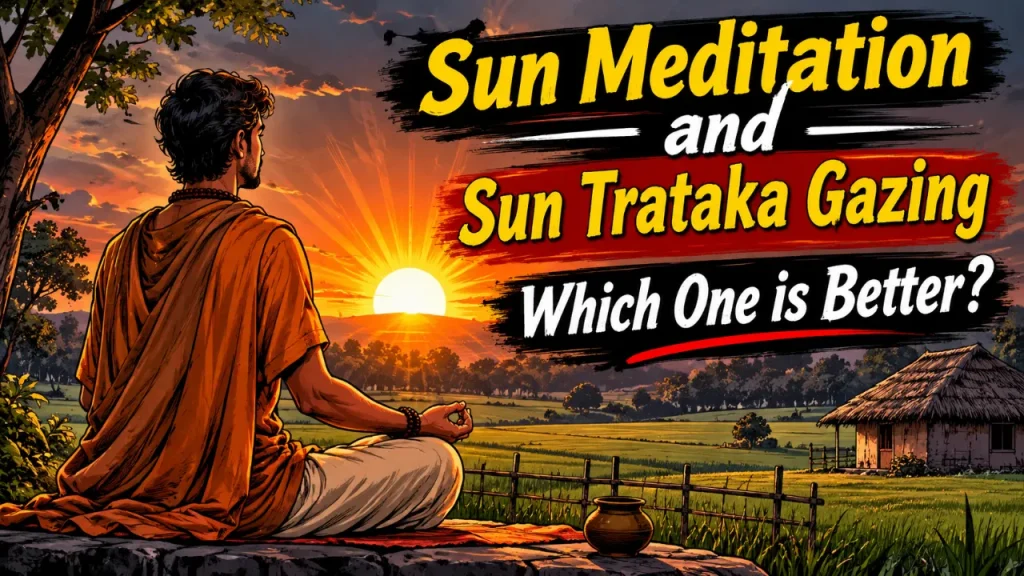
If you are new to trataka gazing meditation and want to perform sun meditation, I suggest first reading my guide to trataka meditation and practicing with a simple dot or Shakti chakra trataka. These build the same one-pointed attention in a controlled setting.
Once that foundation is in place, you can decide how Surya Trataka fits into your own practice.
- What is sun gazing meditation?
- The Spiritual Benefits of Sun Gazing
- How to perform Sun meditation: A Simple Step-by-Step Guide
- What Eye Doctors Say
- Common Mistakes you should avoid during sun meditation
- Is Surya Trataka safe?
- Is sun gazing at sunrise safe?
- Can sun gazing improve eyesight?
- How long should you practise?
- What should I practise before sun gazing?
- Is sun gazing the same as sun meditation?
- What does सूर्य त्राटक mean in Hindi?
What is sun gazing meditation?
Sun gazing, also called sun meditation or Surya Trataka, is a yogic practice in which the sun is the point of focus. Trataka means steady gazing, and the idea is to give your full attention to a single object until the mind settles.
Practitioners believe the object you choose becomes the focus of your awareness, and many describe feeling calm, vitality and a sense of connection with nature.
Are sun gazing, sun meditation and Surya Trataka the same?
The three terms are used interchangeably. “Sun gazing” is the popular name, “sun meditation” emphasizes the meditative side, and “Surya Trataka” is the yogic version.
Trataka is mainly a gazing practice, which is why many teachers prefer the word gazing to meditation.
Where it fits in the trataka family
Within trataka, sun gazing is usually described as an external (bahiranga), distant-gazing practice, because the sun is far away.
Traditional teachers treat sun gazing as advanced and recommend starting with gentler forms: bindu, Shakti chakra, candle and moon gazing. These build steadiness of attention.
An important point: these practices train focus, not your eyes’ tolerance of sunlight. Eye doctors say no amount of practice makes looking at the sun safe, which is why the rest of this guide explains the risks and safer alternatives.
The Spiritual Benefits of Sun Gazing
For thousands of years, cultures across the world have honoured the sun as the giver of life: in Vedic Surya worship, ancient Egyptian devotion to Ra, and the sun rituals of Indigenous peoples.
Sun gazing grows from this lineage. It is a sacred meditation of turning toward the light at dawn or dusk and receiving its energy with stillness and gratitude.
Practitioners believe sun gazing awakens the mind, body and spirit, reconnecting us with the natural rhythm of life.
There are so many advantage and benefit of surya trataka or sun meditation like as it helps you to concentrate, vitamin D production, serotonin production, melatonin production and so many other benefits. Now let’s understand other spiritual benefit too.
The Benefits of Sun Gazing, According to Spiritual Tradition are shared here
- Mental clarity and deep focus: Sun gazing is a form of one-pointed meditation. By resting your attention on a single, radiant point, the restless mind learns to settle. Practitioners describe sharper concentration, a quieter inner dialogue and a growing ability to stay present.
- 2. A surge of vital energy: Many traditions teach that the sun is the primary source of prana, or life force. Those who greet the sunrise regularly often describe feeling lighter, more energised and more alive throughout the day.
- 3. Emotional balance and joy: Morning light is associated with uplifted mood and inner brightness. Practitioners speak of releasing heaviness, easing worry and feeling a natural sense of contentment, as though the sun’s warmth reaches the heart as well as the skin.
- 4. Awakening of the third eye: In yogic and mystical teachings, sunlight is linked to the pineal gland, the seat of the third eye and intuition. Devotees believe that sun meditation stimulates inner vision, heightened awareness and spiritual insight.
- 5. Restful sleep and a natural rhythm: Aligning your day with sunrise and sunset helps you live in harmony with nature’s cycles. Many practitioners report deeper, more peaceful sleep and a stronger sense of daily rhythm.
- 6. A deeper connection to nature and source: Beyond physical benefits, sun gazing is a practice of humility and gratitude. Facing the rising sun reminds us that we are part of something vast, creating a sense of belonging, purpose and peace.
These spiritual benefits are from difference source and experience and are shared here for information purpose only.
Read : How to Achieve a Thoughtless State in Trataka Sadhana (Beginner’s Guide)
How to perform Sun meditation: A Simple Step-by-Step Guide
Sun gazing is a traditional meditation practice of gazing the sun at sunrise or sunset and absorbing its warmth and light.
This is step by step basic guide of sun meditation that covers the basics, from timing to technique, so you can start a calm and mindful routine.
Eye-care note: Looking directly at the sun can damage your eyes, even when it looks soft and low.
Keep the practice gentle, never stare at a bright sun, and stop if you feel any discomfort. If you have an eye condition, or want to be extra careful, try the closed-eye version in Step 4.
Step 1: Choose the Right Time
The best times for sun gazing are the first 30 minutes after sunrise and the last 30 minutes before sunset. This time is suitable for sun meditation and beginner time for meditation practice.
The light is softer then, and it’s a peaceful way to start or end your day. Avoid midday, when the sun is at its strongest.
Step 2: Pick a Good Spot
Find an open space with a clear view of the horizon, such as a beach, a field, a park or a hilltop. If you can, stand barefoot on grass, sand or soil. Many practitioners feel more grounded and connected to nature this way.
Avoid rooftops and other unsafe places.
Step 3: Make Sure Your View Is Clear
Stand outdoors rather than behind a window, since glass blocks natural light and spoils the experience.
Your eyes should always be comfortable, so wear whatever you normally need to see safely and never strain to look at the light.
Step 4: Practise Gently
Let your eyes rest softly on the glow of the horizon, or close them and feel the sun’s warmth on your face. Keep it brief, and look away or close your eyes whenever the light feels too bright.
Blink often and stay relaxed. Cloudy days work too, as you can simply turn toward the brightest part of the sky and feel the light.
Step 5: Breathe and Meditate
Sun gazing is a form of meditation, so pair it with slow, steady breathing. Let your mind quiet down, set an intention or offer a moment of gratitude. Finish with a minute or two of stillness before you go about your day.
Quick Tips for Beginners for sun meditation practice
- Start with short, comfortable sessions.
- Practise at the same time each day to build a habit.
- Keep a simple journal of how you feel afterwards.
- Speak to an optometrist if you have any concerns about your eyes.
You can practice sun meditation with above step by step guide but, as per my recommendation you should practice from basic to advance trataka practice and start with bindu trataka, Shakti chakra trataka and candle trataka then moon gazing as it enhance your eyesight and boost focus for better experience. You can explore basic of trataka in hindi and 5 reason that affect practice
Read : 5 secret Signs of success in Tratak Sadhana you need to know
What Eye Doctors Say
First we have to clear understanding about retinopathy is. It is damage to the central retina, the macula, and it is commonly linked to sun gazing and eclipse viewing. The Cleveland Clinic lists religious sun gazing as a risk factor.
According to eye experts damage from sun meditation and gazing at sun it can be painless. The retina has no painful nerves, so symptoms appear 4 to 6 hours later, sometimes after 12.
One ophthalmologist says this painlessness is part of what worries eye professionals.
Why damage can happen in seconds. The Canadian Ophthalmological Society says even a few seconds of looking at the sun can be dangerous.
The eye works like a magnifying glass, focusing the sun’s energy onto the retina, and about a quarter of patients are left with permanent damage.
Even as a factor sunrise and sunset both aren’t safe. UV is lower at sunrise and sunset, but that doesn’t mean zero risk. If you have any eye problems we don’t advises looking at the sun at any time of day, including sunrise.
Using Sunglasses and practice don’t help to avoid side effect of sun gazing. Ordinary sunglasses, even very dark ones, are not safe for looking at the sun.
Who Should Not Practise It
Eye doctor’s advice against looking directly at the sun for anyone. If you are in any of these groups, avoid the practice completely.
- Existing eye conditions. Glaucoma, retinal problems or dry eye can make the eyes less able to cope with intense light.
- Recent eye surgery. Healing eyes are more fragile and need protection from bright light.
- Light sensitivity or migraines. Intense light can trigger symptoms and discomfort.
- Children. Children are more commonly affected by solar retinopathy.
Gentler alternative: closed-eye sun meditation, feeling the warmth on your face, carries none of these risks.
Common Mistakes you should avoid during sun meditation
- Forcing the gaze. Curiosity or “pushing through” the glare is risky. Brightness normally makes people look away quickly, before damage occurs, so overriding that reflex removes your main protection. If the light feels uncomfortable, look away.
- Practising at midday or in bright light. The sun is strongest then, but a low sun is not a safe alternative.
- Believing in a safe time limit. Many guides suggest building up from seconds to minutes. One eye-care article points out that building up to 30 minutes is more than enough time to harm the eyes.
- Assuming focus protects the eyes. Concentration or meditative calm has no effect on how light reaches the retina.
- Trusting social media guides. There are so many social media guide about sun gazing claims “misleading” so check any guide against an eye-care professional.
Safer approach: keep your eyes closed and enjoy the warmth on your face.
Read : Spiritual benefit of Sri Yantra Meditation How to Perform Tratak on form of Shree Yantra
The safest approach to perform sun meditation Conclusion
Sun gazing grows out of an ancient reverence for the sun from so many different culture especially from ancient Indian culture, and Surya Trataka belongs to the yogic discipline of steady gazing.
Trataka meditation Practitioners perform the focus, calm and sense of connection it brings, and that tradition deserves respect.
The medical view is just as clear. Eye doctors warn that looking directly at the sun, even at sunrise or sunset, can cause solar retinopathy.
It is often painless at the time, it can happen within seconds, and no safe duration has been established. Sunglasses and practice don’t change that.
The good news is that the benefits people look for, such as sharper concentration, a quieter mind and a calmer start to the day, don’t require staring at the sun. Safer options include:
- Closed-eye sun meditation: feel the warmth on your face and follow your breath.
- Candle or dot trataka: the same steady-gazing discipline with a gentle focal point.
Continue your practice:
- Read our complete guide, What Is Trataka Gazing Meditation?, for the full tradition, techniques and timing.
- Learn the safe way to gaze with Candle Gazing Meditation: The Untold Truth and Risks.
- New to gazing? Begin with Bindu Trataka, the simplest and most beginner-friendly form.
This article is for general information and is not medical advice. If you have looked at the sun and notice blurred vision, blind spots or distortion, see an eye doctor promptly.

Frequently asked question and their answer about sun meditation
Is Surya Trataka safe?
Surya Trataka is the yogic practice of gazing at the sun. Trataka means “to gaze” or “to look.” Eye doctors warn that looking directly at the sun can cause permanent retinal damage, and no safe duration has been established. Some yoga manuals advise against practising trataka on the sun. Candle or dot trataka is the usual safer alternative.
Is sun gazing at sunrise safe?
No. UV is lower at sunrise and sunset, but that doesn’t mean zero risk. doing practice at that time can be feel comformatble but it is not suitable for a long time.
Can sun gazing improve eyesight?
from spiritual aspect and perspective, practitioner believe that sun meditation can make your eyes morre sharp and full of energy. it absorb the power of sun and enhance your life force that helps you to easily make an impression over others.
How long should you practise?
There is no established safe duration for looking at the sun. Guides that build up to 30 minutes describe more than enough time to cause harm. For closed-eye sun meditation or candle trataka, keep sessions short and comfortable, and stop if your eyes feel strained.
What should I practise before sun gazing?
Start with practices that don’t involve the sun: slow breathing, closed-eye meditation and candle trataka with a teacher. Palming, cupping warm hands over the eyes, is used afterwards to relax them. People with epilepsy are advised not to practise candle trataka. If you’re unsure, see an eye doctor first.
Is sun gazing the same as sun meditation?
Not exactly. Sun meditation is a broad term for meditating in sunlight, including with your eyes closed and the warmth on your face. Sun gazing, or Surya Trataka, means looking at the sun with open eyes, which is the risky part. Closed-eye sun meditation is the safer choice.
What does सूर्य त्राटक mean in Hindi?
सूर्य (Surya) means “sun” and त्राटक (trataka) means “to gaze” or “to look steadily,” so सूर्य त्राटक means gazing at the sun. Trataka is one of the six yogic cleansing practices (shatkarma), and it is more often done on a candle flame.
Follow Us & Stay Connected
Enjoyed this article? Follow us for more fascinating stories, mysteries, spirituality and the unexplained.


