How to Achieve Thoughtless state in Trataka Meditation: The Easiest Way.
Many practitioners of Trataka meditation wonder how to achieve a state of thoughtlessness in Trataka meditation and whether it is possible to experience complete mental silence.
During deep meditation, some people notice unusual experiences where they feel deeply present and yet strangely detached at the same time.
It may feel as if awareness expands beyond the immediate surroundings, creating a sense of calm observation rather than constant mental activity. This experience is often described as thoughtless awareness or a no thought state.
In this state, the stream of continuous thoughts gradually slows down, and the mind becomes quieter. Rather than reacting to every thought, emotion, or external event, you begin to observe everything as a witness.
You remain aware of what is happening around you, but without immediate judgment or emotional attachment. This does not mean losing consciousness or physically disappearing; instead, it is a state of deep inner stillness and heightened awareness.
Such kind of state called Thoughtless State in Trataka meditation and it’s a kind of peaceful experience.

Practices such as candle gazing and mirror gazing in Trataka meditation can help improve concentration and naturally reduce mental distractions.
With regular practice, many practitioners experience moments where thoughts become less dominant and awareness feels clearer and more focused.
The easiest way to achieve a state of thoughtlessness through Trataka is not by forcefully stopping thoughts, but by allowing attention to become deeply absorbed in a single point of focus.
In the sections below, we will explore this process in detail and understand how to move toward a deeper meditative state.
What is thoughtless awareness or Thoughtless State in Trataka meditation?
In Indian philosophy and yogic traditions, the human mind and consciousness are commonly described through four levels of awareness, often referred to as the states of human awareness.
These stages explain how consciousness functions under different conditions of experience.
- Jagrut (Waking State): This is the state of the conscious mind in which we perceive and interact with the physical world through our senses. It is the state we experience during normal daily activities.
- Swapna (Dream State): This is the state in which consciousness becomes active in the world of dreams. Even though the body is resting, the mind continues creating experiences through images, emotions, and memories.
- Sushupti (Deep Sleep State): This is the state of deep sleep where awareness of the external world becomes minimal. The mind appears quiet, although subtle mental processes may still exist.
- Turiya (The Fourth State): Turiya is often described as a thoughtless state beyond the mind — a condition of pure awareness that exists beyond ordinary mental activity. It is sometimes explained as a state of “being while going beyond the usual sense of self.”
Many spiritual traditions suggest that Trataka meditation can help practitioners move toward deeper states of concentration and awareness.
Out of these four states, we naturally experience the first three in our daily lives through waking, dreaming, and sleeping.
The fourth state, however, is considered a deeper meditative experience and is often associated with thoughtless awareness. You can experience Thoughtless State in Trataka meditation.
In this condition, the continuous flow of thoughts gradually begins to slow down.
At first, small gaps may appear between thoughts. With regular meditation practice, these gaps can become longer, creating moments of mental stillness and deep inner peace. Rather than forcefully stopping thoughts, the process happens naturally as attention becomes more focused and stable.
To understand how to achieve a thoughtless state in Trataka meditation, consistent practice and proper technique are important. By following the right Trataka methods and maintaining regular practice, you can gradually develop greater concentration and move toward deeper meditative experiences such as the Turiya state also known as higher self-state of mind.
Start Here: Learn Trataka Meditation the Right Way
New to Trataka? Before exploring advanced techniques, build a strong foundation with our complete beginner’s guide. Discover what Trataka meditation is, its scientifically and traditionally recognized benefits, step-by-step practice instructions, the best time to meditate, common mistakes to avoid, safety precautions, and different Trataka methods—all in one comprehensive guide.
📖 Read the Complete Trataka Meditation GuideWhy Is the State of Thoughtlessness Important?
Before learning how to achieve a thoughtless state in Trataka meditation, it is important to understand why this state is considered valuable in many spiritual and mental practices.
A thoughtless state, also known as thoughtless awareness, is often described as a condition where the constant stream of mental activity becomes quiet, allowing deeper focus and inner stillness to emerge.
Many meditation traditions believe that a calm and focused mind can help practitioners develop stronger concentration and heightened self-awareness. Because of this, practices involving deep mental focus often emphasize reducing distractions and improving attention.
You can see importance of Thoughtless State in Trataka in these practice:
- Psychic ability practices
- Hypnotism and suggestion techniques
- Telepathy and mind-related experiments
- Energy or distance healing practices
- Spiritual growth and self-realization
The idea behind these practices and getting tap into Thoughtless State in Trataka meditation is that when the mind becomes less distracted by continuous thoughts, attention can become more stable and focused.
Rather than constantly reacting to mental noise, a person may experience greater clarity and a stronger sense of awareness.
In Trataka meditation, developing this state is not about forcefully stopping thoughts. Instead, it is about gradually training the mind to stay focused on a single point until moments of deep stillness begin to arise naturally.
Now that you understand the importance and how to achieve Thoughtless State in Trataka meditation, let’s explore how to practice and develop it through Trataka meditation.
Can you force the mind to become thoughtless?
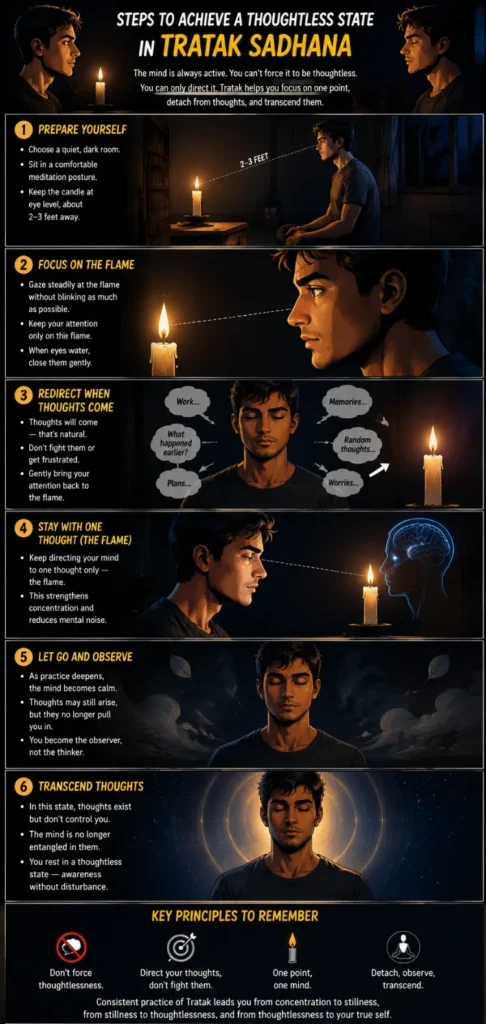
Thousands of thoughts pass through our minds every day. You cannot force your mind into becoming completely thoughtless because the mind is naturally designed to stay active and continuously shift from one thought to another.
What you can do, however, is learn to direct your thoughts and consciously guide your attention while reducing unnecessary mental distractions.
A thoughtless state does not mean that thoughts suddenly disappear. It is a state in which the mind no longer becomes trapped or attached to thoughts but simply allows them to arise and pass naturally.
In this state, thoughts lose their control over us, and our awareness begins to rise above them. You can gain such control with Thoughtless State in Trataka meditation regular practice.
In Trataka Sadhana, the process begins by training the mind to focus on a single point or a single stream of awareness.
As concentration deepens, the inner self gradually starts awakening, and the practitioner naturally moves beyond the constant flow of thoughts.
The mind itself does not become empty; rather, we learn to detach ourselves from thoughts by consciously directing our attention.
Understanding this principle is one of the most important keys to success in Trataka practice.
Once you stop trying to force the mind into silence and instead learn to guide it properly, the journey becomes smoother and more effective. This is the master rule to tap into Thoughtless State in Trataka gazing meditation and why most of practitioner failed.
Why thoughts increase during Trataka
While practicing Trataka meditation, many practitioners notice something unexpected: instead of thoughts decreasing, the number of thoughts seems to increase.
This often creates confusion, and beginners may feel that they are doing the practice incorrectly. However, in many cases, this is a natural part of the process.
One of the biggest reasons this happens is the constant effort to forcefully stop thoughts. Most of us make mistake here and this stop us to tap into Thoughtless State in Trataka meditation.
Many people begin Trataka with the belief that meditation means completely eliminating every thought from the mind. In reality, thoughts cannot simply be switched off by force.
The more you struggle to stop the mind, the more attention becomes focused on the thoughts themselves, causing the mind to become even more entangled in mental activity.
Similarly, if you practice Trataka while forcefully keeping your eyes open or creating physical tension, the mind may become restless and repeatedly drift toward unwanted thoughts and distractions.
Meditation works more effectively when practiced with relaxed awareness rather than mental struggle.
Another reason thoughts may increase during Trataka meditation is that the mind gradually shifts from conscious activity toward deeper layers of awareness.
During this process, suppressed emotions, old memories, and hidden thought patterns may begin to rise to the surface.
Many practitioners experience memories from the past or emotions they had forgotten. Sometimes they become absorbed in these experiences and lose focus.
Rather than fighting or suppressing these thoughts, it is better to observe them without attachment and simply allow them to pass naturally.
These experiences may be a sign that the mind is releasing accumulated mental impressions and moving toward a quieter and more balanced state. With regular practice, the flow of thoughts can gradually settle, leading to greater inner stillness and deeper concentration.
Step-by-step easiest method How to Achieve a Thoughtless State in Trataka Meditation
Thoughtless simply means a state beyond continuous mental activity. It is a condition where thoughts related to the past and future no longer dominate the mind, and we become deeply connected with the present moment.
Remaining fully present is considered one of the first conditions for entering a thoughtless awareness or Nirvichara state.
Many people believe that during meditation they should focus on stopping unwanted or intrusive thoughts. However, this is one of the most common misunderstandings.
Whether you practice meditation or Trataka meditation, the goal is not to forcefully stop thoughts. Instead, you should learn to observe thoughts as they arise and pass away.
When we start observing without reacting, the chain connecting one thought to another gradually begins to weaken. This is called Thoughtless State in Trataka gazing meditation.
When there is no emotional reaction or involvement with a thought, unwanted thoughts naturally begin to lose their intensity. Gradually, the mind becomes less entangled and more relaxed.
Over time, small gaps begin to appear between thoughts. As these gaps become longer, moments of mental stillness begin to emerge. This eventually develops into a state of thoughtless awareness.
Let us understand some important tips that can help make this experience easier during Trataka meditation practice.
Practice Trataka on an Empty Stomach
This is the basic but important tips to for achieving Thoughtless State in Trataka meditation. During Trataka practice, many practitioners experience increased alertness and mental focus.
For this reason, meditation practices are generally considered more comfortable on an empty stomach or after allowing sufficient time after a meal.
Practicing immediately after eating can sometimes create discomfort, heaviness, or drowsiness, making concentration more difficult.
For both mindfulness meditation and Trataka meditation, it is generally recommended to practice after waiting approximately 1–2 hours after a light meal or longer after a heavy meal.
Do Not Start Trataka Immediately After Waking Up
Many beginners make a common mistake: they wake up and directly sit for Trataka practice. You can’t achieve Thoughtless State in Trataka gazing meditation without right preparation.
Instead, spend 10–15 minutes preparing your body and mind. You can take a short walk in fresh air, focus on your breathing, or practice gentle pranayama.
This preparation may help:
- Increase alertness
- Reduce sleepiness
- Improve focus
- Calm mental restlessness
Without preparation, many practitioners experience yawning, lack of concentration, or drowsiness during practice. This will also help you to tap into Thoughtless State in Trataka gazing meditation easily.
Create the Right Environment for Trataka
The surrounding environment can significantly affect your concentration. To tap into higher awareness and Thoughtless State in Trataka you need suitable environment.
Even if you sit with full intention, background noise and repeated distractions can continuously pull your attention away from the practice.
Try to create a peaceful and comfortable environment during Trataka meditation:
- Choose a quiet place
- Reduce unnecessary distractions
- Keep lighting comfortable
- Maintain a stable sitting position
If creating complete silence is difficult, you may use earplugs or noise-reducing headphones to minimize external distractions.
A quieter environment helps reduce mental disturbance and allows attention to become more stable. This is necessary to tap into Thoughtless State in Trataka meditation.
Practice Eye Exercises before Trataka
Many beginners notice eye strain during practice. Eyes may feel tired, watery, or uncomfortable while maintaining a steady gaze.
Simple eye exercises before practice may help relax the eye muscles and improve comfort.
For example:
- Move the eyes gently up and down
- Look left and right slowly
- Rotate the eyes in a circular motion
- Blink naturally before beginning practice
Steady and relaxed eyes can help create a more comfortable Trataka experience.
Do Not Become Obsessed with Stopping Thoughts
One of the most important principles of meditation is learning to observe rather than fight with the mind. Focus on stopping thought won’t help you to achieve Thoughtless State in Trataka it create unwanted thought again and again.
Many people believe concentration means stopping all thoughts. In reality, forcefully stopping thoughts often creates more mental struggle.
Imagine sitting inside a moving train. Outside the window, different scenes continue passing by. Thoughts are similar. If you become attached to every passing scene, you become distracted. But if you simply observe without becoming involved, the scenes continue moving without affecting you.

Thoughts work in a similar way.
When you stop reacting to them, the mind gradually becomes quieter. New thoughts become less intense, and natural gaps begin to appear between them.
These gaps may slowly deepen into moments of stillness and eventually lead toward thoughtless awareness.
Thoughts often become stronger when the mind constantly moves between the past and the future. Becoming fully present in each moment naturally reduces mental noise and allows greater inner peace to emerge.
Common mistakes beginners make
In Trataka Sadhana, practitioners often go through different challenges while training the mind to become more focused and disciplined. Because of impatience or lack of proper guidance, many people do not follow the essential steps of the practice correctly.
These mistake stop us to achieve Thoughtless State in Trataka and practitioner don’t get success.
Such kind of mistake can affect their overall experience and progress.
Trataka Sadhana is considered a yogic practice that aims to develop concentration and gradually guide awareness toward deeper levels of the mind.
With regular and proper practice, it may help improve focus, inner stillness, and self-awareness.
If you want to achieve better results in a shorter period during Trataka Sadhana, it is important to follow the recommended methods and prepare both the body and mind before beginning practice.
A natural and balanced approach can make the experience more comfortable and effective.
There are some basic principles that every practitioner should keep in mind before practicing Trataka. These foundational steps can help create the right conditions for concentration and support a smoother meditation experience.
Signs you’re entering a deeper state
I still vividly remember that after practicing Trataka for more than 12 days, I began experiencing unusual changes during meditation.
Within a few minutes of practice, my mind would become extremely quiet, and it sometimes felt as though the body and mind were functioning separately.
It created a sensation of deep detachment, as if awareness had shifted away from ordinary mental activity into a different state of perception.
For many practitioners, experiences like these can arise unexpectedly during the early stages of practice. this Thoughtless State in Trataka is an amazing experience as a beginner.
Initially, they may feel unfamiliar or even surprising, but with regular practice they often become easier to understand and observe calmly.
As concentration deepens, practitioners may also experience a stronger connection with their inner self, a greater sense of calmness, and increased awareness of thoughts, emotions, and surroundings.
Many people describe feeling more present, becoming less reactive, and noticing subtle details that they would normally overlook in daily life.
As Trataka practice continues over time, some practitioners report experiencing heightened intuition or a stronger sense of awareness about situations and events around them.
These experiences can vary from person to person and should simply be observed without becoming overly attached to them.
Rather than focusing only on unusual experiences, the real purpose of Trataka is to develop inner stillness, clarity, and deeper self-awareness.
Read : What Is Trataka gazing Meditation? Amazing Benefits, Techniques, and Beginner’s Guide (2026)
how to achieve thoughtless state during trataka meditation conclusion
Understanding how to achieve a thoughtless state in Tratak Sadhana is not about forcefully stopping every thought that appears in the mind.
The mind naturally creates thoughts, memories, and emotions, and trying to suppress them often creates more restlessness. The real purpose of Tratak Sadhana is to train awareness and gradually develop a state where thoughts lose their control over us.
With regular practice, patience, and the right approach, the mind slowly becomes calmer and more stable.
As concentration deepens, small gaps begin to appear between thoughts, and over time these moments of silence can expand into a deeper experience of inner stillness. This process happens naturally and should never be rushed.
Simple practices such as creating a peaceful environment, preparing the body before meditation, observing thoughts without reacting, and practicing consistently can make the journey easier. Every practitioner may progress at a different pace, so comparing experiences with others is unnecessary.
The journey of how to achieve a thoughtless state in Tratak Sadhana is ultimately a journey toward self-awareness, inner balance, and deeper connection with the present moment. Focus on the practice itself, and allow the experience to unfold naturally with time.
Frequently Asked Questions About Thoughtless State in Trataka Meditation
Q. Can Trataka stop thoughts completely?
No, Trataka meditation does not aim to completely stop thoughts by force. Thoughts are a natural function of the human mind and continuously arise due to memories, emotions, experiences, and daily activities. During Trataka meditation, the goal is not to fight with thoughts but to reduce your attachment to them.
As concentration improves, you may notice that thoughts become less intense and the mind feels quieter. Over time, gaps may begin to appear between thoughts, creating moments of stillness and peace. Rather than completely eliminating thoughts forever, Trataka helps you become less controlled by them and more aware of them.
Q. How long does it take to achieve a thoughtless state?
There is no fixed timeline for achieving a thoughtless state because every practitioner has a different mental condition, level of focus, and consistency of practice.
Some people may experience brief moments of mental silence within a few days or weeks, while others may require months of regular practice. Factors that can affect progress include:
Consistency of practice
Mental distractions and stress levels
Lifestyle and sleep quality
Practice environment
Proper Trataka technique
Instead of chasing the result, focus on practicing regularly. Deep experiences often develop naturally with patience and discipline.
Q. Is thoughtlessness the goal of Trataka?
Not completely. Thoughtlessness is generally considered a stage or experience that may arise during Trataka practice, but it is not the only purpose of the practice.
The broader goals of Trataka meditation include:
Improving concentration
Developing self-awareness
Increasing mental clarity
Creating emotional balance
Deepening meditation practice
If you become obsessed with achieving a thoughtless state, you may create unnecessary mental pressure. Trataka works more naturally when attention remains relaxed and focused.
Q. Why do more thoughts appear during meditation?
Many beginners become worried because they notice more thoughts during meditation instead of fewer. This is a common experience and does not necessarily mean that the practice is failing.
During daily life, the mind is usually occupied with external activities and distractions. When you sit quietly for meditation, you begin observing thoughts that were already present but previously unnoticed.
In some cases, old memories, emotions, and suppressed mental patterns may also come to the surface. Instead of resisting them, simply observe them without reaction. The more you struggle against thoughts, the stronger they may appear.
Q. What are signs of success in Trataka Sadhana?
The signs of progress in Trataka Sadhana can differ from person to person. Success should not only be measured through unusual experiences but also through positive changes in daily life.
Some commonly reported signs include:
Improved concentration and focus
Greater mental calmness
Reduced restlessness
Increased awareness of thoughts and emotions
Better ability to stay present
More emotional stability
Deeper meditation experiences
Feeling more peaceful and relaxed
Some practitioners may also experience temporary sensations such as light perception, inner stillness, or heightened intuition. These experiences should simply be observed without becoming attached to them.
The most important sign of progress is often a gradual increase in inner peace and awareness in everyday life.