
What if simply staring at your own shadow could reveal something far deeper than you ever imagined? Discover the Shadow Person Ritual, its connection to Shadow Trataka gazing ritual practice meditation, reported experiences, benefits, safety tips, and psychological explanations.
For centuries, people from different spiritual traditions have practiced shadow gazing as a form of meditation, self-discovery, and inner exploration.
Some describe it as a powerful way to strengthen concentration, while others believe it can awaken hidden aspects of the mind—or even lead to mysterious spiritual experiences.
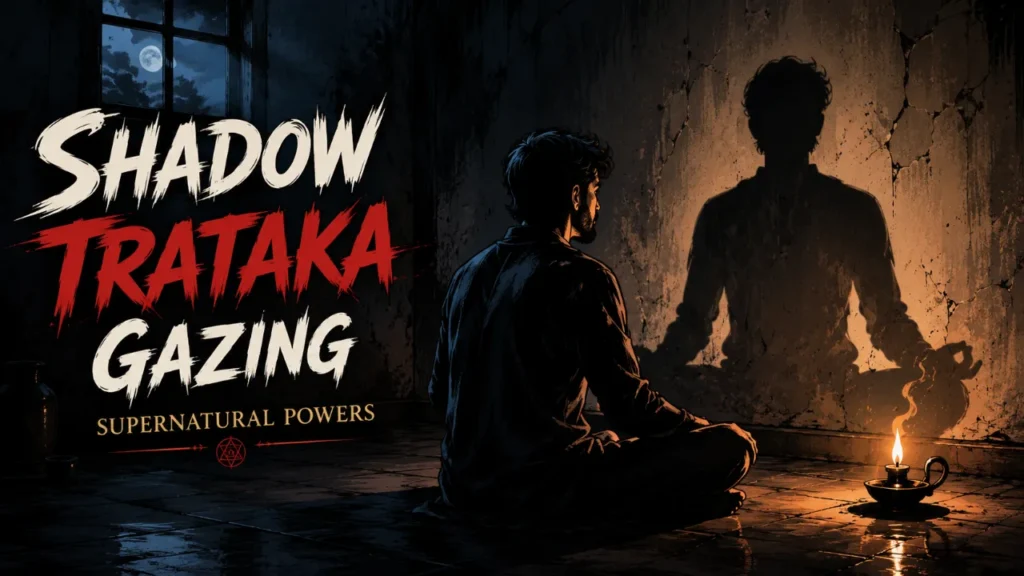
Many practitioners of the Shadow Person Ritual claim that, after several minutes of focused gazing, they begin noticing unusual changes.
Their shadow may appear to move, distort, change shape, or even seem like a separate figure standing before them.
While some interpret these experiences as spiritual encounters, psychologists often explain them as natural effects of prolonged visual focus and altered perception.
So, what is the truth? Is the Shadow Person Ritual an ancient meditation technique rooted in Trataka, a symbolic journey into the subconscious mind, or simply an optical illusion created by the brain?
The answer depends on whether you approach it from a spiritual, psychological, or scientific perspective.
In this article, you’ll discover
- The origins of the Shadow Person Ritual
- Its connection to Trataka meditation
- How to practice it safely
- The experiences people commonly report
- Its possible benefits and risks
- The difference between traditional yogic teachings and modern paranormal beliefs.
Whether you’re a curious beginner or an experienced meditation practitioner, this guide will help you understand the practice with an open mind and a balanced perspective.
- What Is the Shadow Person Ritual?
- Is there any mention of a 'Shadow Person Ritual' in ancient yoga?
- What Is Hamzad?
- Types of Shadow Trataka gazing ritual practice Meditation
- Chandra Trataka (Moon Shadow Trataka gazing ritual practice)
- Night-Time Shadow Trataka gazing ritual practice Practice
- Precautions during the Practice
- Common Experiences during Shadow Trataka gazing ritual practice
- Things to Know About Shadow Trataka gazing ritual practice and Chhaya Purush Sadhana
- Common Mistakes Beginners Make
- How Long Does It Take to Notice Results?
- Myths about the Shadow Person Ritual
- What is the Shadow Person Ritual?
- Is Shadow Trataka dangerous?
- Can beginners practice it?
- How long should I practice?
- Can I practice every day?
- Can Shadow Trataka improve concentration?
- Is it connected with Hamzad?
- What should I do if I feel scared?
- What should I expect after meditation?
What Is the Shadow Person Ritual?
The Shadow Person Ritual is a kind of meditation and shadow-gazing practice in which a person focuses on their own shadow for several minutes in a quiet, dimly lit environment.
As concentration deepens, the shadow may appear to change shape, move, or resemble another figure.
While some people view these experiences as spiritual, psychologists often explain them as natural visual illusions caused by prolonged staring and changes in perception.
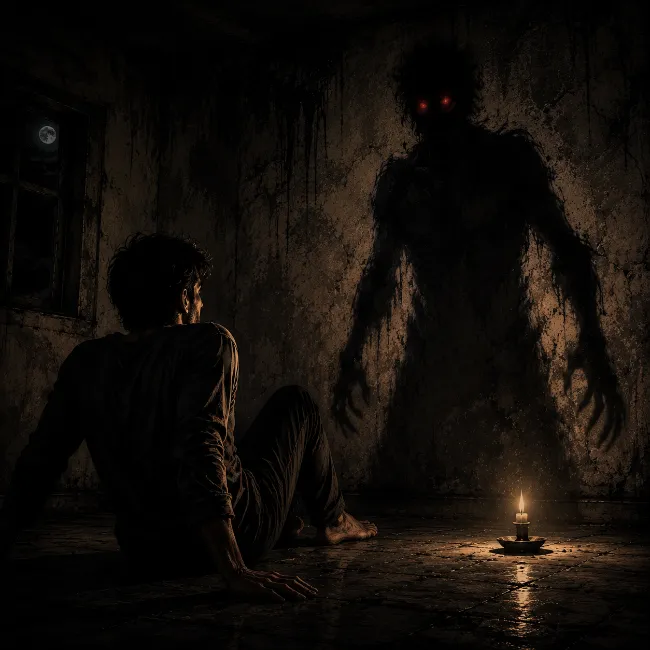
The ritual gets its name because practitioners sometimes report seeing what looks like a “shadow person”—a dark, human-like figure that seems separate from their own body.
In paranormal folklore, shadow people are often described as mysterious entities. However, in this practice, the figure is generally understood to be an altered perception of your own shadow, not proof of a supernatural presence.
Many people also see the ritual as a form of self-exploration.
Your shadow can symbolically represent hidden emotions, fears, or aspects of your subconscious mind. By quietly observing it, practitioners aim to develop greater self-awareness, emotional insight, and concentration.
It is important to distinguish the Shadow Person Ritual from paranormal legends.
Folklore presents shadow people as supernatural beings linked to ghost stories and unexplained encounters, whereas the meditation approach treats the experience as a psychological or symbolic effect of focused attention.
Although many participants describe the ritual as intense and meaningful, there is no scientific evidence that it summons spirits or other entities.
Instead, it is best understood as a meditation practice that combines deep focus, perception, and personal interpretation.
If you’d like, I can also make this version Make this version more mysterious and engaging while keeping it SEO-friendly.
Is there any mention of a ‘Shadow Person Ritual’ in ancient yoga?
The short answer is—no. There is no ancient yoga text that specifically describes a practice called the ‘Shadow Person Ritual’ or claims that staring at one’s shadow will cause a supernatural power or entity to manifest.
Traditional Trataka (one of the six cleansing practices or Shatkarmas of yoga) involves steadily gazing at an object—such as a candle flame, a black dot, a sacred symbol, or the image of a deity—to enhance concentration and prepare the mind for meditation.
Classical yoga texts do not list staring at one’s shadow as a standard technique of Trataka.
However, later esoteric and mystical traditions experimented with various gazing methods involving mirrors, reflections, crystals, and shadows.
These Shadow Person Ritual practices were often employed for meditation, symbolic self-discovery, or divination, rather than as part of mainstream yoga.
In many cultures, folk beliefs have associated the shadow with the soul, a hidden identity, or spiritual energy. These stories vary by region and are rooted in local traditions rather than historical yoga teachings.
According to some beliefs, ancient times did feature practices designed to awaken inner powers—such as Kritya or Chhaya Purusha (Shadow Being)—concepts that have been referenced since antiquity.
Some Tantric interpretations view the shadow as a symbol of the subconscious mind or the hidden aspects of a person’s personality.
While such symbolic concepts exist within certain spiritual traditions, there is no widely accepted Tantric text that describes the modern ‘Shadow Person Ritual’ in the way it is presented online.
Most of the information currently circulating about the ‘Shadow Person Ritual’ originates from modern internet forums, social media, and paranormal websites.
Claims that it opens a portal, manifests a power or entity, or triggers supernatural experiences are not supported by classical yoga texts or scientific evidence.
Instead, the practice is best understood as a blend of focused meditation, visual perception, personal symbolism, and evolving folklore.
Relationship between Shadow Trataka gazing ritual practice and Hamzad
Although Shadow Trataka gazing ritual practice and Hamzad are often mentioned together on social media and paranormal websites, they come from different traditions and should not be considered the same practice.
What Is Hamzad?
The word Hamzad (also spelled Hamzad or shadow-self) comes from Islamic occult traditions and refers to a spiritual “double” or counterpart believed by some esoteric practitioners to exist alongside every person.
While the concept appears in certain mystical and occult writings, it is not a mainstream belief in Islam and is not established in the Qur’an or authentic Hadith as a ritual involving shadow gazing. This is the most common Shadow Person Ritual by gazing own shadow.
Islamic Occult Traditions
In some historical Islamic occult literature, advanced practitioners claimed that intense spiritual exercises, isolation, fasting, and repeated prayers could help them communicate with or understand their Hamzad.
These practices belong to esoteric traditions and are separate from orthodox Islamic teachings.
Similarities between Shadow Trataka gazing ritual practice gazing meditation practice and Hamzad
People compare the two because both involve:
- Long periods of intense concentration.
- Encountering what feels like a second version of oneself.
- Experiences interpreted as spiritual or psychological.
- Personal reports rather than scientifically verified phenomena.
Key Differences between Shadow Person Ritual and Trataka gazing
Despite these similarities, they are fundamentally different. Shadow Trataka gazing ritual practice is a shadow-gazing meditation that focuses on perception, concentration, and self-awareness.
Hamzad is an occult concept about a spiritual counterpart and is not traditionally practiced through shadow gazing.
Their historical origins, beliefs, and purposes are unrelated.
Why People Confuse Them
The confusion largely comes from modern internet content, where stories from yoga, tantra, paranormal folklore, and Islamic occult traditions are often mixed together without historical evidence.
Because both involve mysterious experiences and the idea of seeing another version of oneself, many websites incorrectly present them as the same practice. In reality, there is no reliable historical source that directly connects Shadow Trataka gazing ritual practice with the Hamzad tradition.
Types of Shadow Trataka gazing ritual practice Meditation
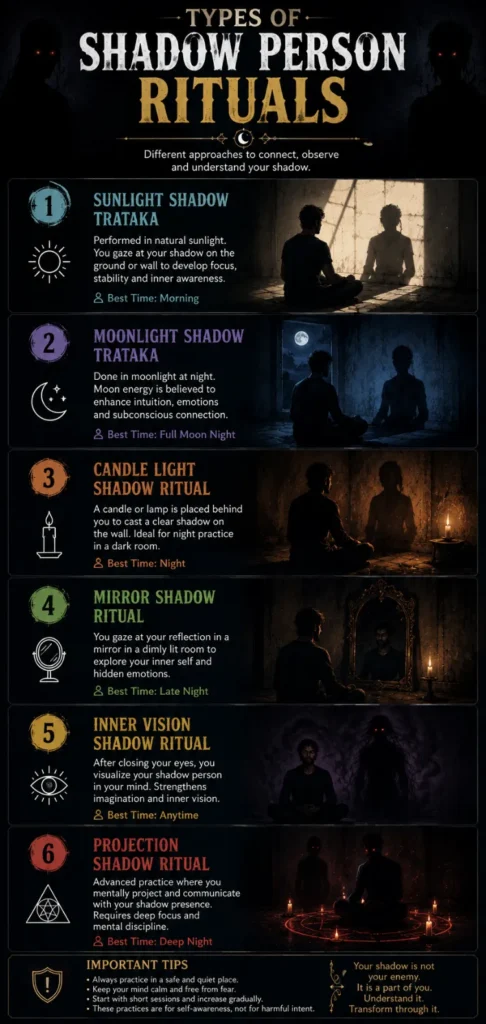
Shadow Trataka gazing ritual practice can be practiced in different ways depending on the light source used to create the shadow. While these methods share the same principle of focused observation, each offers a unique experience. Most reported effects are subjective and can vary from person to person.
1. Sun Shadow Trataka gazing ritual practice
Sun Shadow Trataka gazing ritual practice is performed outdoors using natural sunlight to create a clear body shadow.
Best Timing: Practice during the early morning or late afternoon when sunlight is soft and your shadow is long. Avoid midday sunlight, as it can strain the eyes and create harsh shadows.
Environment: Choose a quiet, open space with a flat surface where your shadow is clearly visible.
Steps:
- Stand comfortably facing away from the sun.
- Focus your gaze on the head or upper body of your shadow.
- Keep your body still and breathe naturally.
- Continue for 5–10 minutes if you are a beginner.
Expected Experiences: Some practitioner’s report that the shadow appears to move, change shape, or look unfamiliar. These experiences are commonly linked to prolonged visual focus and natural changes in perception.
Read : Unlocking the Mysteries: A Guide to Creating and Using Your Book of Shadows
2. Moon Shadow Trataka gazing ritual practice
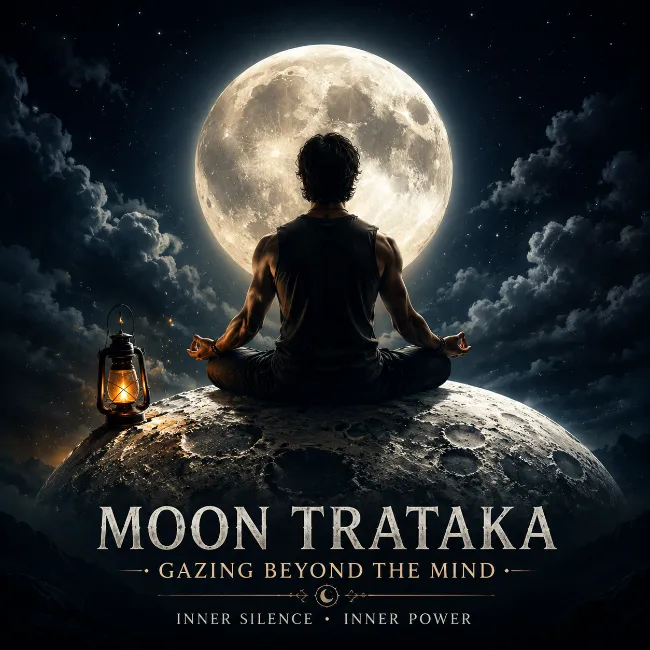
Moon Shadow Trataka gazing ritual practice uses the soft light of a bright moon to create a faint shadow.
Why Moonlight Is Used: Moonlight produces a gentler shadow, making the practice feel quieter and more meditative than sunlight.
Calmness: Many practitioners find moonlight helps create a peaceful atmosphere that encourages relaxation and mindfulness.
Emotional Effects: Some people report feeling emotionally balanced, reflective, or deeply connected with their thoughts after the practice.
Spiritual Symbolism: In many spiritual traditions, the moon represents intuition, inner wisdom, and the subconscious mind. These symbolic associations are cultural and spiritual rather than scientifically established.
3. Lamp Shadow Trataka gazing ritual practice
Lamp Shadow Trataka gazing ritual practice is an indoor version that uses a single lamp or candle to cast a shadow on a plain wall.
Traditional Setup: Place one light source behind you so your shadow appears clearly on a light-colored wall. Keep the room dim and free from distractions.
Beginner Version: Sit comfortably about 4–6 feet from the wall and focus on your shadow for 5–10 minutes. Gradually increase the duration as your concentration improves.
4. Mirror Shadow Trataka gazing ritual practice
Mirror Shadow Trataka gazing ritual practice is often confused with Shadow Trataka gazing ritual practice, but they are different practices.
Difference from Shadow Gazing: Instead of observing your shadow, you gaze at your own reflection in a mirror under dim lighting.
Optical Effects: After several minutes, facial features may appear distorted, unfamiliar, or temporarily change. This phenomenon has been observed in psychological studies of prolonged mirror gazing.
Psychological Explanation: Researchers suggest these experiences result from visual adaptation, reduced sensory input, and the brain’s interpretation of ambiguous images rather than supernatural causes.
For many practitioners, Mirror Trataka serves as a tool for meditation and self-observation rather than paranormal exploration.
Practicing the “Chhaya Purush” (Shadow Being) Sadhana through Surya Trataka (Sun Gazing)
This practice should be performed during a season when the sunlight is neither too harsh nor too dim, and the sky is clear and free of clouds. The month of September is often considered an ideal time.
Stand with your back facing the sun in a quiet, secluded place where there is no foot traffic or disturbance. Slow your breathing and remain completely still while focusing your gaze on your own shadow.
With 15 to 16 days of consistent practice, you may observe changes in your shadow similar to those described in the Hamzad Sadhana. For Chhaya Purush Sadhana through Surya Trataka, the practice is ideally performed around 5:00 PM, shortly before sunset.
After completing 15 to 16 days of practice, cover your face with a red cloth while ensuring you can breathe comfortably. Then, mentally chant the solar Beej Mantra:
“Om Shri Aank”
According to this tradition, the practice gradually strengthens one’s inner spiritual power. As the sun sets, practitioners believe they may experience various divine insights or symbolic visions while observing their shadow.
Similar to the experiences reported during Agni Trataka (fire gazing), this practice is said to strengthen morale, deepen concentration, and enhance willpower.
Traditional teachings also suggest that sustained shadow-gazing through Trataka can lead to profound experiences of Shunyata (the state of emptiness or void).
Note: These descriptions are based on traditional spiritual teachings and personal accounts. They are not scientifically verified, and individual experiences may vary.
Chandra Trataka (Moon Shadow Trataka gazing ritual practice)
In traditional Moon Trataka, practitioners meditate by gazing at the moon shortly after moonrise. In Chandra Shadow Trataka gazing ritual practice, the approach is similar, but instead of looking directly at the moon, the practitioner focuses on their own shadow created by the moonlight.
After gazing at the shadow for some time, gently close your eyes for a few moments and then open them to observe the shadow again.
This cycle is believed to deepen concentration and enhance the meditative experience.
According to traditional teachings, this practice helps practitioners become more receptive to the moon’s subtle energy. It is said to cultivate calmness, emotional balance, and a gentle nature.
During regular practice, some people also report feeling more confident and attractive, particularly noticing a greater intensity or magnetism in their eyes.
Many spiritual traditions believe that the moon influences both the body and the mind.
Although these ideas may sound mythical to some, the moon has long been symbolically associated with emotions, intuition, and mental balance in various cultures.
Traditional practitioners also believe that performing Shadow Trataka gazing ritual practice under moonlight strengthens inner courage (Atmabal) and willpower (Ichchha Shakti).
Some even claim that, with advanced concentration, a practitioner may mentally visualize the moon even when it is hidden behind dense clouds.
Such experiences are regarded as personal spiritual experiences rather than scientifically verified phenomena.
Overall, Chandra Shadow Trataka gazing ritual practice is considered a meditative practice that combines concentration, symbolism, and self-observation, and practitioners often describe it as a source of deep inner peace and unique spiritual experiences.
Read : 5 Different Types Of Shadow People and their spiritual meaning in our life
Night-Time Shadow Trataka gazing ritual practice Practice
According to certain esoteric traditions, this practice is performed in a room painted entirely in a sky-blue color, including the walls and floor.
The room should remain private, and no one else should enter during the practice.
At approximately 11:00 PM, a single oil lamp or candle is lit. The practitioner then observes their own shadow in silence for an extended period before briefly shifting their gaze toward the sky.
Some occult traditions claim that this practice can assist in the realization of the Hamzad or spiritual counterpart.
However, these beliefs are based on esoteric teachings and are not supported by scientific evidence or mainstream religious doctrine.
Traditional practitioners also describe experiencing intense, symbolic, or even frightening visions during advanced stages of practice. Because of these reports, it is generally advised not to combine multiple forms of Trataka in an attempt to achieve faster results.
Precautions during the Practice
Traditional teachings recommend maintaining a sattvic (pure and balanced) lifestyle throughout the practice. Since Trataka is believed to increase inner heat and mental intensity, some practitioners report temporary restlessness or emotional sensitivity.
Many teachers recommend the following precautions:
- Eat a balanced diet that includes milk, yogurt, fresh fruits, and other cooling foods.
- If following the advanced night-time practice, spend as much time as possible in solitude and avoid unnecessary distractions.
- Refrain from discussing your spiritual experiences with others until the practice is complete, and observe silence whenever possible.
- Beginners who wish to explore Shadow Trataka gazing ritual practice at home are generally advised to practice only the basic, meditation-focused methods rather than advanced occult variations without qualified guidance.
Traditional practitioners believe that Shadow Trataka gazing ritual practice itself is not harmful when practiced responsibly. They also suggest that the depth of one’s experiences depends largely on mental stability, concentration, and consistency.
However, individual experiences vary, and extraordinary or supernatural claims associated with the practice have not been scientifically verified.
Common Experiences during Shadow Trataka gazing ritual practice
People who practice Shadow Trataka gazing ritual practice often describe a wide range of experiences. It is important to understand that these experiences are highly subjective and vary from person to person.
Some practitioners interpret them as spiritual, while others view them as natural effects of deep concentration and prolonged visual focus.
One of the most common experiences is shadow distortion. After staring at a shadow without moving the eyes for several minutes, the shadow may appear to change shape, grow larger or smaller, move slightly, or resemble another figure.
These effects are commonly associated with visual adaptation and the brain’s interpretation of limited visual information.
Some practitioners also notice light flashes, shimmering patterns, or subtle colours around the shadow. Others report visual afterimages that remain visible for a few moments after closing or shifting their eyes.
These are well-known visual phenomena that can occur naturally after prolonged steady gazing.
A few people describe a floating sensation or a feeling that their body has become unusually light or detached.
During deep meditation, some also experience emotional release, such as unexpected joy, sadness, peace, or relief, as suppressed thoughts and emotions come to the surface.
Another commonly reported experience is a feeling of presence, where it seems as though someone else is nearby.
While some interpret this spiritually, psychology suggests that intense focus, expectation, and altered perception can contribute to such sensations.
Perhaps the most consistent benefit reported by practitioners is increased focus and mental clarity. Like other forms of Trataka meditation, regular practice may improve concentration, mindfulness, and the ability to maintain steady attention.
Overall, many of the visual and sensory effects reported during Shadow Trataka gazing ritual practice can occur naturally after prolonged, uninterrupted gazing.
Whether they are viewed as spiritual experiences, symbolic insights, or normal perceptual phenomena depends largely on the individual’s beliefs, expectations, and personal interpretation.
Read : Top 10 fact and Mystery about Shadow Person Ritual You must know
Spiritual Interpretation of Shadow Trataka gazing ritual practice
Many spiritual traditions interpret the experiences of Shadow Trataka gazing ritual practice as more than simple visual phenomena. These interpretations are spiritual beliefs and symbolic perspectives, not scientifically established facts.
Some practitioners believe that prolonged shadow gazing increases awareness of the energy body or subtle body, which is described in various yogic and esoteric traditions as a non-physical aspect of human existence.
Others associate the practice with becoming more sensitive to the aura, believing it represents a person’s spiritual or energetic state.
Another common interpretation is that Shadow Person Ritual helps cultivate inner awareness. By observing one’s own shadow in silence, practitioners believe they become more conscious of their thoughts, emotions, and subconscious patterns.
The shadow is also viewed symbolically as the shadow self—the hidden or less-recognized aspects of one’s personality. In this context, the practice is considered a form of self-reflection that encourages emotional growth, acceptance, and self-understanding.
For many practitioners, the ultimate purpose of Shadow Trataka gazing ritual practice is personal transformation. They believe the discipline of sustained concentration, combined with deep introspection, can strengthen willpower, improve self-awareness, and support spiritual development. These interpretations are rooted in personal experience and traditional teachings rather than scientific evidence.
Psychological Explanation
Many experiences reported during Shadow Trataka gazing ritual practice or Shadow Person Ritual can also be explained through well-known principles of psychology, neuroscience, and visual perception.
One of the most recognized effects is Troxler fading, a visual phenomenon in which stationary objects begin to fade, blur, or change appearance when you stare at a fixed point for an extended period. This can cause the shadow to seem distorted or unfamiliar.
Visual adaptation also plays a role. As the eyes continuously observe the same image, the visual system becomes less responsive to unchanging details, making the shadow appear to shift, expand, contract, or transform.
Changes in peripheral vision can further contribute to these experiences. While maintaining a fixed gaze during Shadow Person Ritual on an objects outside the central field of vision may seem to move or fluctuate, even when they remain stationary.
The imagination naturally fills in missing or ambiguous visual information. Combined with expectation and focused attention, the brain may create meaningful patterns or human-like forms from ordinary shadows.
Prolonged concentration can also produce altered attention, in which awareness becomes deeply focused and external distractions fade into the background. This state is common in many meditation practices and may influence how sensory information is perceived.
Finally, the broader effects of meditation—including relaxation, reduced mental chatter, increased mindfulness, and heightened self-awareness—may explain why many practitioners report emotional clarity, inner calm, and improved concentration after Shadow Trataka gazing ritual practice.
Taken together, these psychological explanations show that many visual and sensory experiences during Shadow Person Ritual by Trataka gazing can occur naturally.
Whether someone interprets them as spiritual insights, symbolic experiences, or normal perceptual effects depends on their personal beliefs and perspective.
Things to Know About Shadow Trataka gazing ritual practice and Chhaya Purush Sadhana
Shadow Trataka gazing ritual practice (Chhaya Purush Sadhana) is generally regarded as a practice centered on concentration, visualization, and the subconscious mind.
Many practitioners believe that regular practice can offer physical relaxation, greater mental focus, and opportunities for spiritual self-reflection.
Traditional teachings describe Chhaya Purush Sadhana or Shadow Person Ritual as one of the more challenging Trataka practices because it requires patience, discipline, and sustained concentration.
However, the basic shadow-gazing methods are generally considered safe for healthy individuals when practiced in moderation and with proper precautions.
The three introductory Shadow Trataka gazing ritual practice methods discussed in this guide are commonly presented as practices that beginners can learn independently.
Even so, anyone interested in advanced or esoteric variations should seek guidance from an experienced teacher.
Practitioners often report improvements in concentration while Shadow Person Ritual, mental stability, mindfulness, and the depth of their meditation.
Many traditions also emphasize that the practice should be approached with a sattvic (pure and balanced) lifestyle, believing that this helps create a calm and disciplined state of mind.
Some spiritual traditions further suggest that Shadow Trataka gazing ritual practice supports inner transformation, strengthens willpower, and develops greater awareness of the subconscious mind.
These interpretations are based on traditional beliefs and personal experiences rather than scientific evidence.
Because the practice involves deep concentration and introspection, it is traditionally recommended to practice in a quiet, secluded place where you are unlikely to be disturbed.
Many spiritual teachers believe that a peaceful environment allows the mind to remain steady and helps practitioners observe their experiences without distraction. This allow you to get beginner success in Shadow Person Ritual practice.
Common Mistakes Beginners Make
Like any meditation practice, Shadow Trataka gazing ritual practice requires patience and consistency. Beginners often make a few common mistakes that can reduce the quality of the practice or create unnecessary discomfort.
Using the Wrong Lighting
Lighting that is too bright can strain the eyes, while lighting that is too dim may make the shadow difficult to observe. Soft, stable lighting creates the most comfortable conditions for practice.
Expecting Supernatural Experiences
Many people begin Shadow Trataka gazing ritual practice expecting to see spirits or extraordinary visions after only a few sessions. In reality, experiences vary greatly, and many practitioners notice nothing more than improved concentration and relaxation.
Practicing for Too Long
Long sessions in Shadow Person Ritual practice do not necessarily produce better results. Beginners should start with 5–10 minutes and gradually increase the duration as their focus improves.
Avoiding Blinking Completely
Although Trataka encourages steady gazing, forcing yourself not to blink can cause eye strain, dryness, and discomfort. Blink naturally whenever necessary and allow your eyes to rest after each session.
Practicing Irregularly
Occasional practice is less effective than a consistent routine. Even short daily sessions are generally more beneficial than infrequent, lengthy practice.
Letting Fear Take Over
Visual distortions, afterimages, or unusual sensations are common during prolonged gazing and are often natural perceptual effects. Becoming fearful can interrupt the practice and increase anxiety. Approach every experience calmly and without expectation.
How Long Does It Take to Notice Results?
There is no fix time for getting success in Shadow Person Ritual by Trataka gazing meditation. The timeline varies from person to person, depending on consistency, meditation experience, and individual expectations.
Week 1
Most beginners become more comfortable with the practice. Mild improvements in concentration and mental calmness may begin to appear, while some people notice temporary visual effects such as afterimages or shadow distortions.
Week 2
With regular practice, maintaining steady attention often becomes easier. Some practitioners report feeling more relaxed, emotionally balanced, or mentally focused during daily activities.
Month 1
After several weeks of consistent practice, improvements in concentration, patience, and meditation quality may become more noticeable.
Some practitioners also describe deeper subjective experiences, although these vary widely and are based on personal interpretation.
Long-Term Practice
Long-term practitioners often report increased mindfulness, stronger self-awareness, and greater mental discipline. Spiritual experiences, if they occur, are highly personal and should not be expected as guaranteed outcomes.
It is important to distinguish these subjective experiences from the well-established benefits of regular concentration and meditation practice.
Myths about the Shadow Person Ritual
Many claims about the Shadow Person Ritual have spread through social media and paranormal websites. Separating myths from reality helps create realistic expectations.
| Myth | Reality |
| Everyone sees spirits during the ritual. | Experiences vary widely. Many people experience only natural visual effects or improved concentration. |
| Shadow distortion always means something supernatural is present. | Visual distortions can occur naturally after prolonged steady gazing due to normal visual perception. |
| The ritual guarantees psychic powers or supernatural abilities. | There is no scientific evidence that Shadow Trataka gazing ritual practice grants paranormal abilities. |
| The longer you stare, the better the results. | Excessive practice can cause eye strain and mental fatigue. Moderate, consistent practice is generally more effective. |
| Beginners should expect dramatic visions. | Most beginners experience gradual improvements in focus and meditation rather than extraordinary phenomena. |
| Shadow Trataka gazing ritual practice is dangerous for everyone. | When practiced responsibly by healthy individuals, it is generally considered a safe concentration exercise. People with serious eye conditions or certain mental health conditions should consult a qualified professional before practicing. |
Shadow Person Ritual spiritual meaning – Final Thoughts
The Shadow Person Ritual remains one of the most fascinating and misunderstood meditation practices discussed in spiritual communities.
For some, it is a powerful method of improving concentration and self-awareness through focused shadow gazing.
Others view it as a symbolic journey into the subconscious mind, while certain traditions associate it with deeper spiritual experiences. Regardless of the interpretation, there is no universal evidence that everyone will experience the same results.
If you decide to explore this practice, approach it with patience rather than expectations.
Shadow Person Ritual is a gradual process, and meaningful progress comes through consistency, self-discipline, and a calm state of mind—not by chasing extraordinary or supernatural experiences.
Even subtle improvements in focus, mindfulness, and emotional awareness can be valuable outcomes.
It is equally important to respect the traditional roots of Trataka meditation while keeping an open yet balanced perspective.
Many visual effects reported during prolonged shadow gazing can have natural psychological or optical explanations, and spiritual interpretations often depend on personal beliefs and cultural traditions.
Understanding both viewpoints allows you to explore the practice responsibly without becoming overly skeptical or overly convinced.
Ultimately, the true purpose of the Shadow Person Ritual is not to prove the existence of paranormal phenomena but to deepen your awareness, strengthen your concentration, and better understand your own mind.
Practice safely, remain curious, and let your personal experience guide your understanding while staying grounded in both wisdom and critical thinking.
FAQ
What is the Shadow Person Ritual?
The Shadow Person Ritual, also known as Shadow Trataka or Chhaya Purush Sadhana, is a meditation practice that involves steadily observing your own shadow to develop concentration, mindfulness, and self-awareness. Some practitioners interpret their experiences spiritually, while others view them as natural effects of prolonged focus and visual perception.
Is Shadow Trataka dangerous?
For most healthy individuals, Shadow Trataka is generally considered a safe meditation practice when performed in moderation. However, practicing for excessively long periods may cause temporary eye strain or mental fatigue. If you have serious eye conditions or certain mental health conditions, consult a qualified healthcare professional before attempting the practice.
Can beginners practice it?
Yes. Beginners can start with simple Shadow Trataka methods using natural or soft indoor lighting. It is best to begin with short sessions of 5–10 minutes and gradually increase the duration as your concentration improves.
How long should I practice?
Most beginners benefit from practicing for 5–10 minutes per session. As you become more comfortable, you may gradually extend the practice to 15–20 minutes, provided your eyes remain comfortable.
Can I practice every day?
Yes. Daily practice is generally recommended because consistency is more beneficial than occasional long sessions. If your eyes feel tired or strained, take a break and allow them to rest.
Can Shadow Trataka improve concentration?
Many practitioners report better concentration, mental discipline, and mindfulness with regular practice. These benefits are similar to those associated with other forms of Trataka meditation and concentration exercises.
Is it connected with Hamzad?
Not directly. Although the two are often linked online, Shadow Trataka and Hamzad come from different spiritual traditions. The connection is largely based on modern interpretations rather than historical evidence.
What should I do if I feel scared?
If you experience fear, anxiety, or unsettling visual effects, calmly end the session, rest your eyes, and return to normal activities. Remember that prolonged steady gazing can naturally produce visual distortions and afterimages. If fear persists, discontinue the practice and seek guidance from an experienced meditation teacher or a qualified mental health professional if needed.
What should I expect after meditation?
Most people experience a sense of calm, improved focus, or mental clarity. Some may notice temporary visual afterimages or unusual perceptions immediately after the practice, which are common effects of prolonged gazing. Spiritual experiences, if they occur, are highly personal and should be viewed as subjective rather than guaranteed outcomes.
Follow Us & Stay Connected
Enjoyed this article? Follow us for more fascinating stories, mysteries, spirituality and the unexplained.