Star gazing Trataka is a yogic concentration practice in which you gaze steadily at a single star, or a small cluster of stars, on a clear night, and then close your eyes to hold its image in your mind.
It is a form of distant Trataka, in the same family as moon gazing, and it uses the night sky as a natural anchor for your attention. Most of us look at the stars the way we scroll a phone: briefly, and with a restless mind. Star gazing Trataka asks for something different.
Instead of naming constellations or counting what you can see, you choose one point of light and let your gaze rest on it. The sky is wide and quiet, and there is nothing to read, answer or fix. That simplicity is what makes the practice so helpful for a busy mind.
Like candle and Bindu Trataka, the practice follows one simple movement. You gaze with open eyes until they feel tired or begin to water, then you close them and keep the inner image of the star alive in your mind.
This second stage is called Antar Trataka, or internal gazing, and it is where concentration deepens. Many practitioners find that the vastness of the night sky helps the mind settle, and that the calm feels different from what a flame or a dot provides.
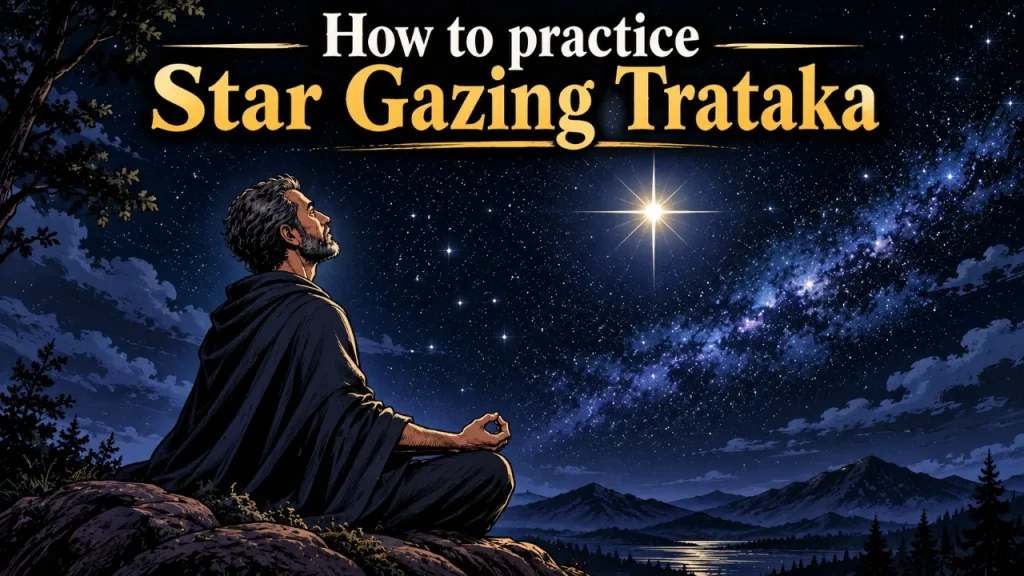
In this guide, you will learn what star gazing Trataka is, how it differs from ordinary stargazing, the best conditions for practice, and a step-by-step method you can start tonight.
You will also find common mistakes to avoid, how long to practice, and simple safety tips for practicing outdoors in the cold. Whether you are new to Trataka or already practice with a candle, this is a gentle way to bring your meditation under the open sky.
What Is Star Gazing Trataka?
Practicing Trataka Sadhana while gazing steadily at a single star is known as Tara Trataka, or Tara gazing.
Star gazing Trataka of this kind raises an obvious question: with countless stars in the night sky, which one should you practice on?
Choose a star that is visible to the naked eye and slightly brighter than those around it, so that you can identify it easily each night. Then practice on that same star every night.
A single fixed point builds familiarity and keeps the mind from wandering between objects.
As your gaze becomes steady, you may notice changes in how the star appears. It may look clearer than the other stars, or seem to disappear for a while and then return.
These are experiences of the practice, not goals, so observe them calmly and keep your attention on the star.
Tara gazing is an advanced stage of Trataka Sadhana. It should be practiced only after you are comfortable with Near Trataka and Antar (Internal) Tratak, which train the eyes and the inner image this practice depends on.
Let us now look at the step-by-step method.
Star Gazing Trataka vs Ordinary Stargazing
Many of us remember counting stars as children until we fell asleep. Ordinary star gazing works the same way: it momentarily clears unwanted thoughts and makes it easier to focus.
Tara Tratak asks for more. When I began practicing on a single star, I noticed changes in how the star appeared, and over time I had experiences I can only describe as telepathic vision.
I share this as my personal experience, not as a promise. Your own experience may differ.
| Aspect | Star Gazing Trataka (Tara Tratak) | Ordinary Stargazing |
| Purpose | Concentration, mental stillness and self-awareness | Observing, enjoying and learning about the night sky |
| Focus | One fixed star, the same star every night | Many stars, constellations, planets or other sky objects |
| Choice of object | A star visible to the naked eye and slightly brighter than those around it, so it is easy to identify | Whatever is interesting or visible that night |
| Method | Steady, fixed gaze, then closing the eyes to hold the inner image (Antar Tratak) | Free looking, often with a star map, app, binoculars or a telescope |
| Effect on the mind | Builds deep concentration over time, with regular practice | A brief clearing of unwanted thoughts, easier focus, and calm (like counting stars as a child) |
| Spiritual aim | Described in tradition as leading to divine experiences and, for advanced practitioners, telepathic vision | None, it is simply enjoyment of the sky |
| Prerequisites | Best practiced after Near Tratak (candle or Bindu) and Antar Tratak | None |
| Repetition | A regular nightly practice on the same star | Occasional, varied from night to night |
| What you may notice | The star may look clearer than others, or seem to disappear for a while and then reappear | New objects and patterns in the sky |
| Conditions | Night, a clear sky and a quiet, safe place | Clear, dark skies, often away from city light |
Best Conditions for Practice
Tara Tratak depends on a clear view of your chosen star, so the right conditions make a real difference. Prepare these before you begin.
Choose the Right Night
Practice at night under a clear sky. Clouds, haze or mist hide faint stars and make it hard to keep your gaze on one point.
A night with little or no moonlight also helps, since a bright moon washes out the surrounding stars and makes your star harder to identify. Check the weather before you go out, so you don’t lose the session to cloud cover.
Choose a Quiet, Safe Place
Find a place where you can see the sky clearly and will not be disturbed.
A terrace, rooftop, open garden or quiet field all work well. Bright Street lights and nearby buildings reduce visibility, so move away from them where you can.
Choose a place you know well, because you will be practicing in the dark and your attention should stay on the star, not on your surroundings.
Practice at the Same Time and Place
Because the practice uses the same star every night, a regular routine helps. A fixed place and a similar time each night make it easier to find your star quickly and settle into the gaze.
Dress Warmly and Sit Comfortably
Cold distracts the mind. Wear warm clothing in cooler months and bring a mat, blanket or chair so that your spine stays comfortably upright. Discomfort breaks concentration.
Be Ready Before You Begin
- Choose your star beforehand so you are not searching for it while you practice.
- Keep your phone away or on silent.
- Make sure you have already practiced Near Tratak and Antar Tratak, since Tara Tratak builds on them.
How to Practice Star Gazing Trataka, Step by Step
Star gazing Trataka follows the same pattern as other forms of Tratak: a steady outer gaze, then an inner image. Complete the preparation first. You should be comfortable with Near Tratak and Antar Tratak, and your place and clear sky should be ready.
Step 1: Choose Your Star
Pick a star that is visible to the naked eye and slightly brighter than those around it, so that you can identify it easily. Choose it before you begin, and use the same star every night.
Step 2: Settle into a Steady Posture
Sit comfortably with your spine upright, on a mat, a blanket or a chair. Rest your hands on your knees or in your lap. Keep your body relaxed and still, because a steady body supports a steady gaze.
Step 3: Calm Your Breath
Take a few slow, natural breaths and let the body settle. Do not force the breath. The aim is to arrive at the practice calm, not tense.
Step 4: Fix Your Gaze on the Star
Look at your star and hold your gaze on it without straining. Keep the eyes soft and let your attention rest on that one point of light. If the mind wanders, bring it back to the star.
Step 5: Observe Without Chasing
As your gaze steadies, you may notice changes in the star. It may look clearer than the others, or seem to disappear for a while and then reappear. Treat these as part of the practice, not as goals. Observe them calmly and keep your attention on the star.
Step 6: Close Your Eyes and Hold the Inner Image
When your eyes feel tired or begin to water, gently close them. Keep the image of the star in your mind and rest your attention there. This is Antar Tratak, the internal gazing you practiced earlier, and it is where the concentration deepens.
Step 7: Return Gently
If the inner image fades or the mind drifts, do not force it. Open the eyes, look at your star again for a short time, and repeat the process.
Step 8: Close the Practice Slowly
When you finish, rub your palms together until they are warm and place them gently over your closed eyes for a few moments (palming). Then open your eyes slowly and sit quietly for a minute before you move.
Tips for Steady Progress
Practice regularly. A short session every night is better than an occasional long one.
Do not strain the eyes. The aim is concentration, not endurance. If your eyes tire, close them and continue inwardly.
Be patient with experiences. Do not chase them or expect them quickly.
How Long Should You Practice?
Tara Tratak is a practice of quality, not endurance. A calm, steady gaze matters far more than the number of minutes.
Start Short
Begin with 5 to 10 minutes a night. If you can hold the gaze for only a short time before your eyes tire, that is normal. Close your eyes, hold the inner star, and continue from there.
Increase Gradually
After several weeks of regular practice, many practitioners extend to 10 to 20 minutes as concentration improves. Add time slowly and only while the practice stays comfortable.
Practice Every Night
Because you use the same star each night, regular practice matters more than long sessions. A short session every night builds more than an occasional long one.
A Simple Rule
If your eyes feel strained, tired or very watery, stop gazing and continue with the inner image. Never push through discomfort to reach a set time.
Benefits You May Notice
The benefits of Tara Tratak are described in terms of experience, and results vary from person to person.
- Deeper concentration. Gazing at one fixed star night after night trains the mind to rest on a single point.
- A calmer mind. Like counting stars as a child, steady gazing quiets unwanted thoughts. With Tara Tratak the effect deepens with regular practice.
- Stronger inner visualization. Holding the star’s image with closed eyes strengthens Antar Tratak.
- Greater self-awareness and discipline. A nightly routine builds patience and steadiness.
- Changes in how the star appears. Practitioners often report the star looking clearer than others, or seeming to disappear and then return.
- Spiritual experiences. In the tradition, and in my own practice, long and regular Tara Tratak has brought deeper spiritual experiences, including what I describe as telepathic vision. This is my personal experience, not a promise, and yours may differ.
Common Mistakes to Avoid
Straining the Eyes
Forcing the eyes open for as long as possible causes strain and watering. Gaze softly, and close your eyes when they tire.
Changing Stars
Switching between stars scatters the practice. Choose one star that is visible to the naked eye and slightly brighter than those around it, and stay with it every night.
Skipping the Earlier Stages
Tara Tratak should come after Near Tratak and Antar Tratak. Without them, the gaze and the inner image are harder to hold.
Chasing Experiences
The star may look clearer or seem to disappear, but these are not goals. Waiting for them makes the mind restless, so observe calmly and return to the star.
Practicing Tired or Cold
Cold and fatigue break concentration. Dress warmly, sit comfortably, and avoid practicing when you are very sleepy.
Practicing Irregularly
Skipping nights weakens the steadiness the practice builds. Choose a time you can keep.
Expecting Quick Results
Tratak is a gradual discipline. Judge your practice by consistency, not by how fast experiences arrive.
My Personal Experience with Star gazing Tratak
In the tradition I follow, a practitioner is advised to practice star gazing Tratak regularly for about four months. Spiritual master describe the result as clairvoyance: with eyes closed, you contemplate a place and it appears clearly before the inner eye.
The example usually given is a place you have never visited, such as the Qutub Minar in Delhi.
My own experiences began before I understood any of this.
A spontaneous experience in 11th grade. One day I fell asleep in class. Suddenly I saw myself near my home in my village.
A girl from my neighborhood, who often visited our house, was sitting in a corner, crying, and some people were passing by. It lasted a few minutes, and then I was back in the classroom.
A week later I told her what I had seen. She was surprised, because it matched what had happened that day. I would call it a kind of remote viewing experience.
Frequently asked question about star gazing
Which star should I choose for star gazing Tratak?
Choose a star that is visible to the naked eye and slightly brighter than those around it, so you can identify it easily every night. Then practice on that same star each night. Using one fixed point builds familiarity and steadiness, and it keeps your attention from wandering between different stars.
How do you practice star gazing Tratak step by step?
Choose your star, sit with your spine upright, and settle your breath. Gaze at the star softly, without straining. When your eyes tire or water, close them and hold the star’s image in your mind. End slowly by placing warm palms over your closed eyes before opening them.
How long should you practice star gazing Tratak each night?
Beginners to this stage can start with 5 to 10 minutes a night and extend to 10 to 20 minutes as concentration improves. Regular nightly practice matters more than long sessions. If your eyes feel strained, close them and continue with the inner image instead of forcing the gaze.
How long does it take to see results from star gazing Tratak?
In the tradition I follow, about four months of regular practice is advised, but results vary from person to person. Some practitioners notice changes in the star’s appearance early on, such as it looking clearer or seeming to disappear and return. Experiences are not guaranteed, so judge progress by consistency, not speed.
Can beginners practice star gazing Tratak?
It is best practiced after Near Tratak (such as candle or Bindu gazing) and Antar Tratak, since those stages train the gaze and the inner image this practice relies on. If you are new to Tratak, begin with the basics in our complete Trataka guide, then move to the night sky.
Conclusion
Star gazing Trataka is a simple practice with a clear method: choose one star that is visible to the naked eye and slightly brighter than those around it, gaze at it steadily on a clear night, then close your eyes and hold its image within.
Practice on the same star every night, begin only after you are comfortable with Near Tratak and Antar Tratak, and let your gaze stay soft and unforced.
Unlike casual stargazing, which gives the mind a brief rest, this practice builds concentration through regular, patient effort.
Experiences may come, such as changes in how the star appears or the inner visions I described, but they are not the goal. Steady practice, patience and the right intention matter most, and every practitioner’s path is different.
If you are new to Tratak, start with the basics in our complete Trataka guide, and then return to the night sky when you are ready. Choose your star tonight, and let the practice unfold at its own pace.
Follow Us & Stay Connected
Enjoyed this article? Follow us for more fascinating stories, mysteries, spirituality and the unexplained.