At a time when knowledge is turned over to the silencing ancient voices that have been forgotten, the legend of Ziminiar, King of Hell manifests itself.
Like a smoldering spark from a fire that has long been put out, only a few dare to mention him aloud, and hardly anyone claims to know what he actually is.
In contrast to the familiar underworld rulers, which the general mass of people is aware of, Ziminiar is beyond human understanding an entity of darkness, great power and strange mystery.
Some say that he is a ruler of chaos who not only inspires terror but has total mastery over the hidden worlds.
Other people think that there was an attempt to erase the legend of Ziminiar King of Hell from the collective human memory because the knowledge of it might be too dangerous.
What actually intrigues us about that character of Ziminiar is not so much the power that he supposedly has but the fact that hardly anyone knows about him.
He has no big, fancy temples dedicated to him, nor are there popularly known books that describe his empire there are only a few indirect, highly doubtful records, and the disturbing feeling that something extremely old is looming in the background of nothingness.
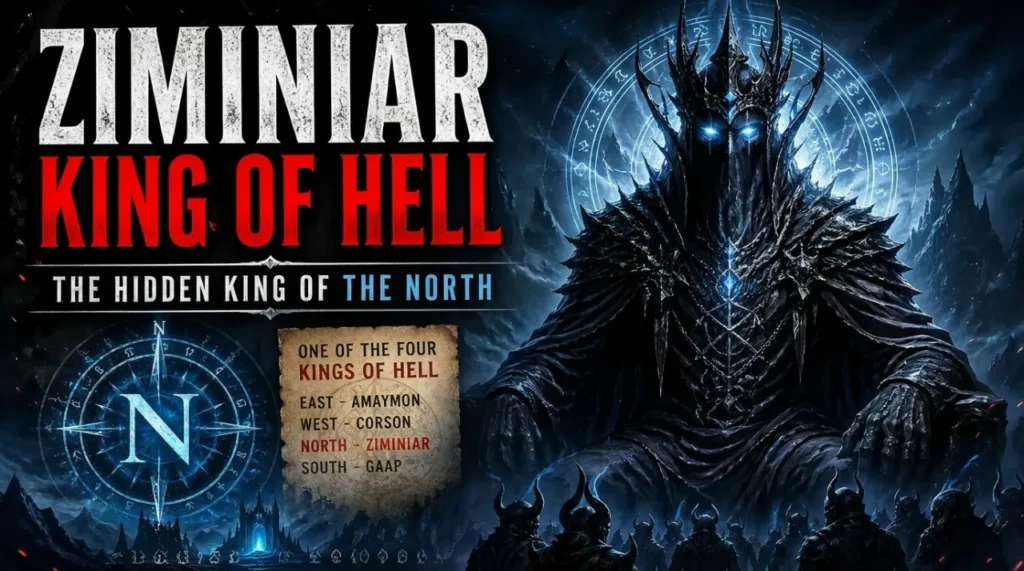
It is the lack of proper information that invites people to ask questions.
So, who or what is Ziminiar King of Hell? Is he a lost myth? Or perhaps a forbidden truth? Or maybe a reality beyond what we are ready to acknowledge?
As we begin to explore this dark legend, one thing becomes certain: Ziminiar is not a story meant for comfort. It is a name that lingers, a presence that unsettles, and a mystery that refuses to stay buried.
Ziminiar the Mighty Demon King in Christian Demonology
In the shadowed traditions of Christian demonology, Ziminiar King of Hell is whispered to be one of the four supreme rulers who command the infernal realms.
These kings are often tied to the cardinal directions, each governing a vast domain filled with legions of obedient demons—and Ziminiar’s authority within this dark order is anything but ordinary.
His name surfaces in fragments, rarely spoke openly, yet always carrying a weight that suggests immense and ancient power.
Unlike more widely recognized figures in demonology, Ziminiar King of Hell exists in a space between myth and obscurity.
He is not celebrated in popular texts, nor frequently depicted in modern interpretations of hell’s hierarchy.
Those who study deeper, older traditions often place him among the most formidable entities to ever rule the underworld. His influence is believed to stretch across unseen dimensions, commanding forces that operate far beyond human understanding.
What makes Ziminiar particularly unsettling is this very obscurity.
While other demons are clearly defined, his story feels incomplete—almost as if parts of it have been lost, hidden, or deliberately erased.
Still, within the ranks of infernal power, Ziminiar King of Hell stands as a silent authority, a ruler whose presence is felt even when his name is not spoken.
Origins and Mythological Background of Ziminiar
The origins of Ziminiar King of Hell trace back to the shadowed world of medieval and Renaissance demonology—a time when scholars and occultists attempted to map the unseen realms with unsettling precision.
In these early traditions, demons were not random forces of chaos but were carefully organized into hierarchies based on power, influence, and their roles within the infernal order.
It is within these ancient grimoires and forbidden texts that the name “Ziminiar” first emerges, quietly yet unmistakably, as one of the four cardinal rulers of hell.
The Four Kings of Hell
Within Christian demonological belief, the idea of the Four Kings of Hell forms a central and chilling structure.
These rulers are said to govern the cardinal directions—north, south, east, and west—each commanding vast legions of demons and embodying a unique aspect of infernal authority:
- Amaymon – King of the East, a powerful cardinal spirit described in The Lesser Key of Solomon
- Corson – King of the West, another dominant force within the same ancient text
- Ziminiar King of Hell – King of the North, the dark sovereign of the northern realms
- Gaap – King of the South, known for his influence and command over spirits
Among these formidable rulers, Ziminiar King of Hell stands as the master of the northern dominion—a region often associated with cold, darkness, and an eerie stillness that mirrors his elusive nature.
His control over the demonic legions in this domain is believed to be vast, absolute, and deeply feared.
Unlike other figures whose legends are more clearly defined, Ziminiar’s presence feels distant yet powerful, as if his influence stretches silently across the infernal landscape without the need for recognition.
This combination of immense authority and lingering mystery is what makes Ziminiar King of Hell such a compelling figure in demonology—an unseen ruler whose power is rarely questioned, even if his story remains only partially told.
Read : Identify an Incubus demon or succubus demon 5 thing to connect with demon and hidden risks
Characteristics and Roles of Ziminiar
The presence of Ziminiar King of Hell within demonological lore carries the same weight as other high-ranking infernal rulers—yet there is something distinctly different about him.
While many demons are defined by chaos or raw destruction, Ziminiar’s identity feels colder, more controlled, and deeply strategic.
His attributes do not just reflect power; they reveal a ruler who thrives on order within darkness, making him one of the most intriguing figures in the hierarchy of hell.
Attributes of Ziminiar King of Hell
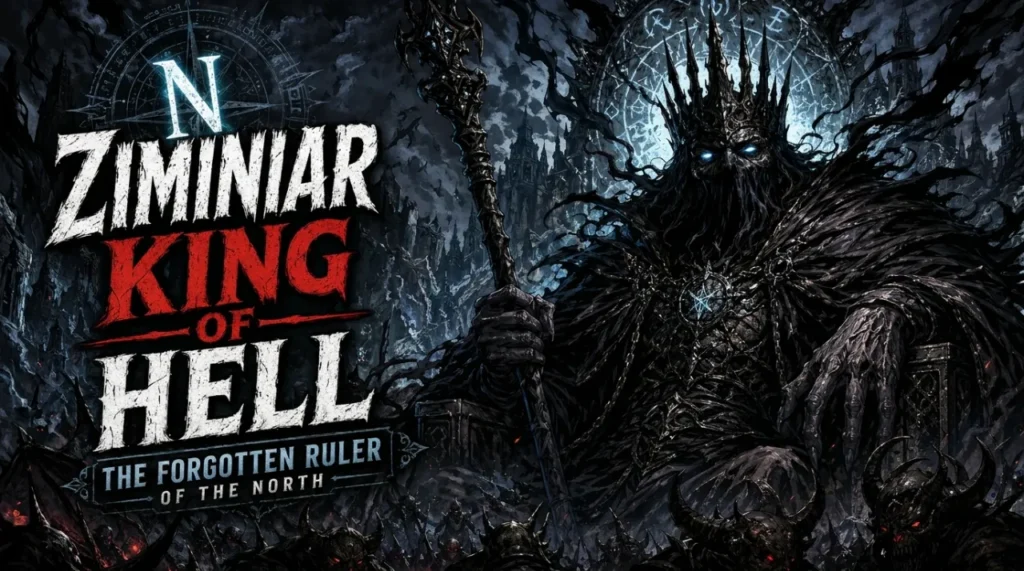
King of the North
As the sovereign of the northern dominion, Ziminiar King of Hell is believed to command one of the most formidable regions of the underworld.
The north, often associated with cold, isolation, and unforgiving stillness, mirrors his nature—distant, calculating, and relentless.
From this shadowed realm, he governs vast legions of lesser demons with unwavering authority.
Mighty Ruler
Ziminiar is not merely a symbolic king; he is depicted as a supreme authority whose command is absolute. Unlike chaotic entities, his power is tied to discipline and control.
Many traditions portray him as a master of structure within the infernal realm, ensuring that even in hell, there is a system beneath the madness.
Elemental Connection
In certain interpretations, Ziminiar King of Hell is linked to elemental forces, particularly earth or the harsh grip of winter.
This association reinforces his image as an unyielding force—steady, immovable, and merciless.
The cold he represents is not just physical, but symbolic of emotional detachment and silent dominance.
Read : Thai urban legend of Kumanthong The Golden boy Ghost 5 Interesting thing to explore
Role in the Demonic Hierarchy
Commander of Legions
At the core of his power lies command. Ziminiar King of Hell is said to rule over countless demons, directing their actions and maintaining order across his domain.
His leadership ensures that the northern reaches of hell operate with precision rather than chaos.
Master of Strategic Warfare
More than just a ruler, Ziminiar is often seen as a tactician. In the unseen conflicts between infernal and celestial forces—or even among demons themselves—he is believed to lead with calculated precision, valuing strategy over brute force.
Influence over the Mortal Realm
Like other powerful entities, Ziminiar King of Hell is thought to extend his reach beyond the underworld.
His influence may appear in subtle, unsettling ways—through chaos, temptation, or unseen manipulation—quietly shaping events in the human world while remaining hidden in the shadows.
This balance of discipline, power, and mystery is what sets Ziminiar apart. He is not just a king of hell—he is a presence that governs from the cold silence of the north, where power speaks softly, but carries absolute control.
Influence in Occult and Demonological Texts
The name Ziminiar King of Hell surfaces most clearly in the shadowy pages of medieval and Renaissance grimoires—texts where the boundaries between knowledge and danger were dangerously thin.
In these occult writings, Ziminiar is not merely described but, in some cases, invoked as a force that could be called upon by those bold—or reckless—enough to attempt it.
Such rituals were never taken lightly.
Summoning a figure of his stature was believed to demand precision, discipline, and a deep understanding of the unseen, as even the slightest mistake could lead to consequences far beyond control.
Presence in Ancient Grimoires
The Lesser Key of Solomon
Among the most well-known sources, Ziminiar King of Hell is linked to certain versions of the Ars Goetia, a section of The Lesser Key of Solomon.
Within these pages, he is counted among the most powerful demonic entities, placing him in a category reserved for rulers rather than servants.
His presence in such a renowned grimoire has made him a subject of fascination for demonologists and occult scholars who seek to understand the deeper structures of infernal power.
Other Esoteric Texts
Beyond this famous work, the name of Ziminiar King of Hell appears scattered across other obscure and esoteric manuscripts.
These references are often brief, almost fragmented, offering only glimpses into his nature. Yet certain details remain consistent—his connection to the northern direction.
His authority over vast demonic legions, and his status as a commanding force within hell’s hierarchy.
What stands out is how little is fully explained. Unlike other demons whose abilities are catalogued in detail, Ziminiar’s story feels deliberately incomplete.
This absence of clarity only deepens his mystique, suggesting that Ziminiar King of Hell is not meant to be easily understood—only acknowledged as a powerful presence lingering at the edges of forbidden knowledge.
Read : How to summon Vine demon The knight of Hell 100% working Ritual to Destroy Your enemy
Conclusion
In the dark hierarchy of Christian demonology, Ziminiar King of Hell emerges as a figure of immense authority and quiet dominance.
As the ruler of the northern realms, he is believed to command vast legions of demons, enforcing order within a domain often associated with cold, shadow, and unforgiving stillness.
His power is not chaotic or reckless—it is controlled, deliberate, and deeply rooted in the structure of the infernal world.
Counted among the feared Four Kings of Hell, Ziminiar King of Hell holds a position that places him far above lesser entities.
His authority is said to shape not only the operations of his own domain but also the balance of power across the wider demonic hierarchy.
While other figures may be more widely known or frequently invoked in popular lore, Ziminiar’s influence feels more distant and absolute—less visible, yet no less formidable.
What makes him especially compelling is the contrast between his immense power and his relative obscurity.
There are no widely detailed accounts of his actions, no dramatic legends that define his rule—only a lingering sense of presence, as though his influence moves quietly beneath the surface.
Within the structure of hell, Ziminiar King of Hell is not just another name; he is a cornerstone of authority, a ruler whose command is rarely questioned and whose reach extends far beyond what is fully understood.
FAQ
Q. Who is Ziminiar King of Hell?
Ziminiar King of Hell is known in Christian demonology as one of the four principal kings who rule over the infernal realm. He specifically governs the northern direction and holds authority over powerful demonic legions. Ancient texts like The Lesser Key of Solomon describe him as a high-ranking ruler with control over many lesser demons.
Q. What powers does Ziminiar King of Hell have?
Ziminiar King of Hell is believed to command vast demonic forces and exercise control through strategy rather than chaos. He is often associated with discipline, authority, and warfare within hell’s hierarchy. Some traditions suggest he has influence over human affairs, causing events tied to chaos, temptation, or destruction.
Q. Why is Ziminiar called the King of the North?
The title comes from demonological systems where hell is divided into four cardinal directions. Ziminiar King of Hell rules the North, a domain often symbolizing cold, darkness, and isolation. This association reinforces his image as a distant, powerful, and calculating ruler.
Q. Is Ziminiar mentioned in the Lesser Key of Solomon?
Yes, Ziminiar King of Hell appears in certain versions of The Lesser Key of Solomon, particularly in connection with the Ars Goetia. He is described as one of the four kings who hold power over the 72 demons said to be bound by King Solomon.
Q. Why is Ziminiar King of Hell so unknown compared to other demons?
Despite his high rank, Ziminiar King of Hell remains obscure because ancient texts provide very limited details about him. Unlike demons such as Lucifer or Asmodeus, his story is fragmented and rarely expanded upon, which adds to his mystery and intrigue among occult researchers.